This Week in College Viability (TWICV) for March 23, 2026
Gary D Stocker (00:01.128)
It is the weekly podcast of This Week in College Viability, News and Commentary. It is not Monday, March 23rd. It's Tuesday, March 24th. Hi, everybody. Gary Stalker in front of the Blue Yeti microphone. I started to record this week's podcast from the soon to be world headquarters of College Viability in Colorado Springs. I didn't like the audio quality yesterday, so it's Tuesday, March 24th, as I am recording the show. And I'm going to draw connection.
Two weeks ago, my wife and I sold our house in St. Louis, not that hard. Last week, we bought a house in Colorado Springs. A lot of work, but not really too hard. Getting inspections done on both, a drill down that is still continuing and will almost certainly be resolved this week, is not that easy. And the reason I bring up houses and inspections
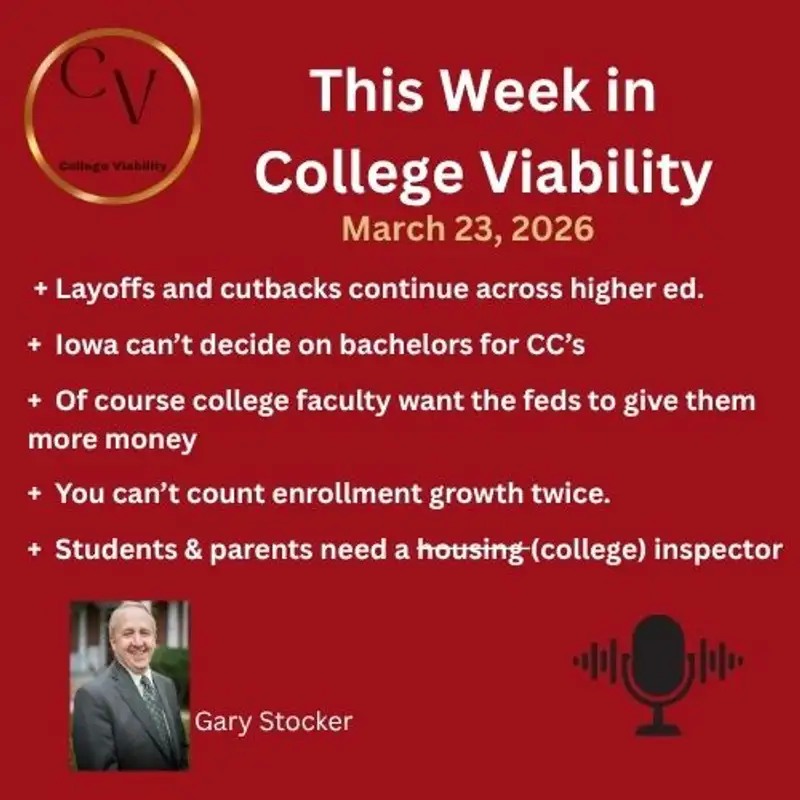
will be the focal point of something that I talk about a little bit later in today's shows. And let's just jump right away to layoffs and cutbacks because there continue to be some. The big news last week, the University of North Texas cut 70 programs to close a $45 million deficit on linguistics, women's studies and 25 minors among those cut. It was associated with the international enrollment. And the story was by Chris John at the University Harold.
21 graduate and 21 undergraduate certificates were being cut. The 25 undergraduate minors had an average enrollment of 20 students and the 21 graduate and undergraduate certificates have an average enrollment of below two students per year. That's 42 programs below two students per year certificates. How long did it take to draw that conclusion? How long were those numbers that bad for that long before the University of North Texas
decided to cut them as they look to close that $45 million budget deficit. Keep in mind, you know, I sell things and the college majors completion app tracks 2,500 public and private colleges, 160 some odd majors from 2020 to 2024. We look at internal market share. We look at external market share. I'll leave a link in the show notes. Here's the startling high price sarcasm alert. $199. Get you that.
Gary D Stocker (02:28.494)
And you can see not just what you have, you may know what your enrollment numbers are. I hope you know what your enrollment numbers are, but let you compare, compare your enrollment in journalism or accounting or whatever to other colleges to know whether there's an opportunity to either engage in revenue sharing with other colleges or where you're really, really weak in majors like University of North Texas just decided here this week. Let's go to the University of Maine to lay off staff as it slashes 5.6 million.
Casey Turman had this story in the Bangor Daily News on March 11th. And let me just talk about the story. The University of Maine is saving 5.6 million by laying off, they want to make sure that they say this, fewer than 10 staff members in the next fiscal year. This is from an email sent by the President, Joan Farini Monday, Tuesday, March 11th, I guess it would be. It's the first look at the cuts. They have a budget deficit. They need to reduce by 7%.
So $18 million shortfall in budget, annual budget, annual revenue over expenses, and more than $1 billion B, is it billion, in deferred maintenance costs on its campus and an expected drop in federal research funding. All right, let's do the math as we do that here. Laying off, let's say 10 people to make the math easy. Laying off 10 people, although they say less than 10, and $5.6 million in cuts.
That's supposed to be the lead that the University of Maine wants us to focus on. They buried the real lead that 10 people making let's just say 50,000 doesn't matter that much. 70,000, pick whatever number you want. 50,000 times 10 is something like $500,000. Double that is still only a million. It doesn't begin to touch the 5.6 million deficit.
and completely ignores the one billion and unfunded, they call it deferred maintenance and other capital expenses. So here's how you read that. They have outdated hardware. They have outdated software, probably modest Wi-Fi, maybe some leaks from the roofs, holes in the parking lot. You get the drift. So buried the lead, spin, spin, spin. We talk about that all the time. This one gets a single geesh page two.
Gary D Stocker (04:56.056)
I've talked about this a couple of times. Iowa wants its community colleges to be able to offer four year degrees. As I shared previously, the private colleges are screaming out loud through the public media arms that that will cause some of them to close. Well, last week, the bill that would establish the opportunity for community colleges to offer four year majors stalled in the Senate.
or somebody, let's see, the Senate Majority Leader, Mike Klemish, says there was no consensus among Senate Republicans. Their lane, he says, is the Senate Majority Leader, Mike Klemish, their lane is specifically designed to help us build a workforce to teach trades, which we have a shortage of in the state, talking about community colleges. And he goes on to say, a study released indicated the state would need to spend more than 20,
million dollars over five years to set up community college programs to award bachelor's degrees at the state's 15 community colleges.
Gary D Stocker (06:04.45)
There are too many. There are too many private colleges and maybe too many community colleges in Iowa. The market will shake that out. And how it shakes out doesn't really concern me. It's a political decision. If they decide to do it, to offer those bachelor's degrees. So be it, if they don't, I don't care. But this is, this is another indication of change that these kinds of discussions generate this much publicity.
This is another indication of change in higher education. developing favorite writer for the Chronicle of Higher Education might be Taylor Schwack. She had a March 19th story that said hundreds of colleges and professors implore the education department to reverse, quote, dangerous, end quote, changes for grad students. Now, Taylor Schwack does a good job of analyzing the numbers, and I'm going to include the link as I always do. You can read that. You can guess.
at the vested interests that college faculty have in keeping the public funds flowing. Let's all go back to economics 101. What these hundreds of college professors imploring the education department to do are to have more dollars chasing the same amount of goods and services, classes, programs, degrees. What does that mean? We have more dollars chasing the same amount, higher prices.
We learned that in Economics 101. There are already too many colleges chasing too few of these graduate students. Consolidation here is the market adjustment that needs to be made and will be made. We don't need more dollars in higher student debt. Let the market lower the number of profitable graduate programs across the country.
and then we'll have less need for student loan dollars to subsidize all of those unneeded college graduate programs. Anyway, you look at the title, hundreds of college professors, money, might as well be what it reads, Taylor. I know you wouldn't do it that way. It's just so obvious. It's just so obvious. It's just you can expect that headline without even having
Gary D Stocker (08:28.12)
Folks say it, it's just, it's a vested interest. They're welcome to do that. This is America.
But they're wrong. They're wrong. They just want their best. They don't want things to change. And we are in an era in higher education, as I have said so many times, of massive change. And these folks don't want things to change for their own reasons. Go get them. Talk about all you want. But there are people like me on the other side saying, you're wrong. Not going to work. Page three.
What's behind the 2025 college enrollment surge? Now, the headline is kind of an old story. It's been around a little bit. Ralph Greco has the story. I had it on March 19th and the minding at Minding the Campus, one really long word, Minding the Campus dot org and the news that dual enrollment high school students was a major component in higher education's increased 2025 enrollment has been previously reported many times.
and that nuance has mostly been ignored by colleges.
Gary D Stocker (09:34.462)
It is a comment in the story by a man whose title is Dr. Ed, Dr. E.D., capital E, capital D, that caught my attention. Takes a kind of a different look at this. Dr. Ed, again, that's a title, not a name, writes in response to this story, the traditional college student entered at age 18 and graduated four years later at the age 22.
Dr. Ed suggests that dual enrollment students enter college at age 16, that's his number, and if they obtain the first two years of education through that dual enrollment program, they will graduate two years after that at the age of 20, age 16 through 20. All right, there's some logic missing here, some logistics missing here, but stay with me. So they will neither be entering college at age 18 nor graduating at age 22. All right, makes sense.
It's going be 16 and 20. Right now, both Cadres of students, he writes, are enrolled in higher education. And that has temporarily boosted the numbers as the college cohort shifts from 18 years old to 22 down to 16 years old to 20 years old. So he makes the case eventually the enrollment will drop because the students who entered at 16
And this is an important point, the students entering at 16 who entered at 16 won't be coming back to reenter at 29, excuse me, where did I get that number from? The students who entered at 16 won't be coming back to reenter at age 18, they'll already be in. So his point is that if we shift undergraduate education into early enrollment, and he likes it, it's good idea.
We'll have a brief bubble, which is what the 2026 stories are about 2025 enrollment. We'll have a brief bubble of increased enrollment, which is not the new normal. And that bubble will quickly end as we shift over into early enrollment. It's a bubble, he says, a two-year bubble probably, not a surge. And I just found this an interesting way to think about, first of the data.
Gary D Stocker (11:55.213)
And secondly, a different way to think about higher education spinning enrollment. We talk about that all the time, all the time, spinning enrollment to their benefit in 2026 from the 2025 data. Again, feel free to do that. But I'm here to say I am your higher education quality coordinator, quality control coordinator. Colleges spin it, but I'm going to spin it right back to use actual data that benefits others, benefits the students and their families and their communities. Page four.
Have you ever, this is not a commercial, have you ever sold your house? Have you ever gone to college or looked at colleges? Sold your house, have you ever? I'm guessing most listeners have. And gone to college again, I'm guessing, or at least looked at colleges, I'm guessing most listeners have. Why did you have an inspector, a housing inspector for one and not an inspector, a college inspector, a college finance inspector for the other?
Think about that. For, you know, our whatever the price house is, we hire somebody, pay them a couple of bucks to make sure the wires are good and they're grounded and the vents work and there's no moles in the yard, whatever. So really what we have now in higher education is comparison. Students and their families compare one college to the other. Majors, location, tuition, faculty, you name it. But really, we need to think about this in the context of inspection.
At some point, let's just assume you've chosen a college. You really need to think, I would encourage college, future college students and their families to look at an inspector kind of concept. And the reason I point this out is of course, that's what we do with the new college viability transparency tool. It looks at transparency, it is the college inspector for colleges, for single colleges, just like you hire an inspector for a house you might have bought.
or somebody else hires an inspector for a house they bought from you. We're going through both of that here in the Stocker household. So back to buying our new home last week. One of our comparison specs looking at houses in the market in Colorado Springs was the laundry room had to be on the main level. We ain't getting any younger and we didn't want to take clothes up and down anywhere in the new home. Had to be. No question if it didn't have a laundry on the main level or tried to spin it that would they say
Gary D Stocker (14:24.386)
laundry in unit. didn't even look. Wasn't on the list.
Call it laundry room on the main level, our equivalent of a major.
If a house had laundry or a major in the basement or didn't offer journalism or whatever, it was not considered.
However, if the house had, they have homeowners associations all over the place in Colorado. If it had a $600 homeowners association fee, that was a specific drill down we use. It didn't rule out a house, didn't rule in a house, but it was one we looked at closely. It didn't always make our list to see, but sometimes it did. Now that we, of course, now that the house is under contract, the one here in St. Louis and in Colorado Springs, housing inspectors have been hired.
They'll dig into everything about the house here and there. Why don't we do that?
Gary D Stocker (15:22.542)
for the colleges that we're spending maybe similar kinds of money two or three or four times depending on the number of children that we have.
And so really college viability, my company is not Zillow where you search for houses. It's not the home tour. College viability is a housing inspector you bring in after you've chosen the college or in the case of our transparency tool, as you choose the college, before you make a costly mistake. In home buying people, and we didn't do this, don't rely on appearances alone. We went through eight houses in one day last week. A house can look beautiful.
It can be in a great neighborhood. can feel like the one, the fit, as we say for colleges.
But housing inspector might find foundation cracks, electrical risks, water behind the walls, termites. And suddenly that dream house, that dream fit, everything changes. And colleges are no different. They can have a great campus tour. They can have strong branding and nice rankings and happy admissions messaging. But underneath,
Underneath there may be declining enrollment.
Gary D Stocker (16:40.76)
There may be weak major completions in accounting or journalism or any of the hundreds of other majors. We track that in the college viability app. It's college majors completion version. The college may have financial instability and may have program cuts waiting to happen. College viability is the inspection, the college inspector layer most families skip. A college can offer a major the same way a house can have a roof.
The real question about that college, the real question about that house is will it still, that roof, is will it still be there and in good condition when you need it to be there. Families treat colleges, college searchers, like an open house. They compare, they tour, they imagine themselves being there, but they skip the most important step. They skip the step of inspection.
Gary D Stocker (17:39.201)
In higher education families commit four years and in almost every case, six figures, often without ever examining the financial health, the enrollment trends, the viability, the popularity, the completion of majors, and much, much more. And that's the role of what I do and others with me at College Viability. We're not the brochure. We're not the tour. We are the inspector.
Because the biggest risks students and their families have are the ones they don't see.
Every college search tool ever built is used around comparisons, side by sides, ranking, score matching. The implicit message of all of them is the same. Find the best option from a set of options. It is subjectivity.
buried as objectivity. The mental model that we've always used treats colleges as interchangeable products, differentiated by features.
It is, I guess, the Amazon product comparison, the same frame applied to a $100,000, $200,000, $300,000 college decisions. Families arriving at college viability carry that framing because it's the only one they know. It's the only one we've ever used. The result is a family who wants to load five colleges into the tool and rank them. And this is not what we do.
Gary D Stocker (19:14.292)
and the gap between what they expect and what they actually get is where confusion lives. So think about that. I'll be talking more about housing inspection and the concept behind it for higher education in the coming weeks and months for sure. If you know someone ready to make a college decision in April before that May 1st deadline, the traditional May 1st deadline, share this podcast with them.
If you want some guidance, drop me a note to Gary at College Viability. It's Gary at College Viability, one long word. Happy to talk you through your college decision and provide a college inspector, become a brief college inspector for you, your student, and your family. Let's call it a wrap. Until next Monday, I'm Gary Stocker at College Viability. Thanks for listening. We'll be back next Monday for sure.