This Week In College Viability (TWICV) for Mar 2, 2026
Gary D Stocker (00:01.194)
It is Monday, March 2nd, 2026. Time yet again for another episode of This Week in College, Viability News and Commentary. Hi, everybody. Gary Stocker sitting in front of the Blue Yeti microphone and using the Riverside.fm software for podcasting this show and others as well. And what do we have on store for this week? Well, there are lawmakers in the country who don't want us to know.
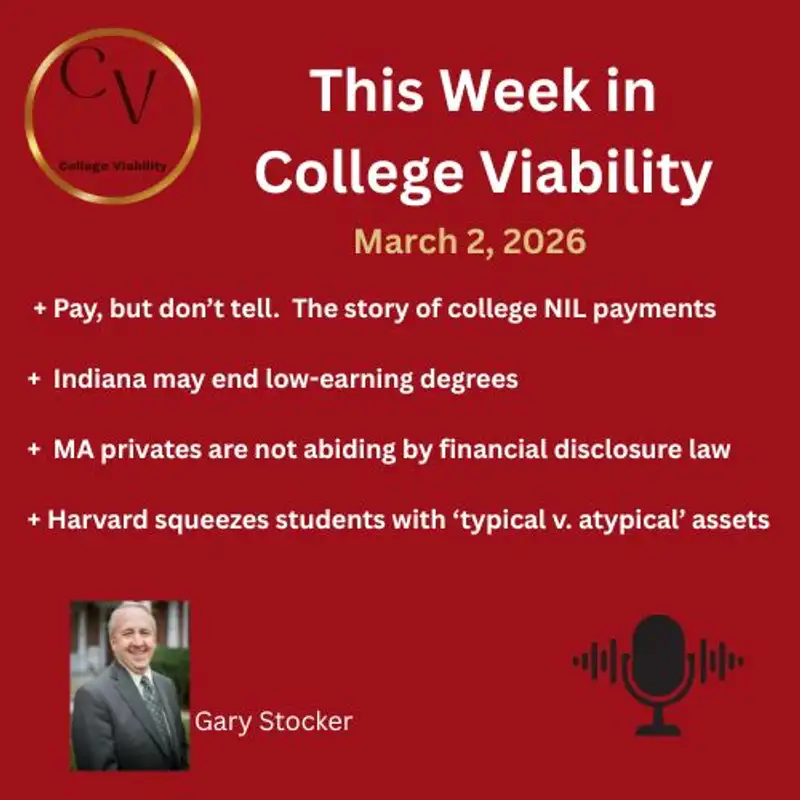
how much college athletes are getting paid. We're going to South Carolina for that story. The United States, as we know, United States government plans to stop funding low earning degrees. Indiana as a state may just end them at public colleges. And there's an editorial that shows up, I believe in the Boston Business Journal, that says New England colleges are urged to disclose financial risks. Well, they're supposed to and they're not.
And we'll talk about that. And then a gray area, Harvard universities, Harvard college kind of sort of one of the same. They're trying to squeeze some extra money out of their students by differentiating between what they're calling typical assets and atypical assets. We'll look at that in some more depth and of course, much, more. And as I usually do at this point in the show, don't be a podcast hog. Make sure to share the podcast link.
with your higher education colleagues, with your friends, family, and others who can benefit from my perspective, additional perspective, on college viability, on the college financial industry as a self, and on what's going on throughout that industry. To layoffs and cutbacks we go. Well, not quite meeting that category. Eastern Illinois University on-campus enrollment drops 9.5 % this spring.
Luke Brewer in the Daily Eastern News had the story on February 25th. EIU's on-campus enrollment dropped 9.5 % compared to last spring with sharply falling international enrollment. know that. This is the lowest, this is from the story from Mr. Brewer, this is the lowest on-campus enrollment has been at Eastern Illinois in the past 10 years with only 3,660 students compared to a little over 4,000.
Gary D Stocker (02:26.72)
last spring. Director of Marketing and Communications, Kristy Kilgore, said the challenge this semester was with enrollment was not just competing with other colleges, get this, but the idea of going to college itself. She goes on to say there's always been people that don't go to college, but now we have to sell not even necessarily our university, Eastern Illinois, but just sell the idea of going to college.
Gary D Stocker (02:59.512)
And they want to add, they want to sell the value of college for those students as well.
Gary D Stocker (03:10.361)
Page two, Wittenberg University offers transfer pathway for Lourdes University students. Now, Lourdes University announced its closure a little earlier this year. Wittenberg University has been on the college viability radar for a long time because they have significant financial issues. This note is from a Wittenberg internal publication, February 23rd. So Wittenberg, a college in financial trouble, soliciting students from a college that has just announced its closing.
It's closing. And this is just asking for students leaving one college, one closed college or soon to be closed college to enroll at another college with significant financial challenges. In my mind, it is borderline irresponsible for colleges with as much financial distress as Wittenberg to solicit students from a closing college when...
that college themselves, Wittenberg, are at some risk of a familiar fate. So if you are one of the students that found yourself at Lowridge University, be careful about accepting offers from colleges like Wittenberg. You can use the tools that we have available. The College Viability Transparency Tool at mycollegeviability.com is one you can use at no cost initially to look at that for colleges you might be considering. All right, changing topics.
Here's a headline from WTOP News on February 19th. Without nationwide rules, South Carolina lawmakers moved to keep college athletic payments secret. College athlete payments secrets. South Carolina is poised to join at least four other states in keeping secret the amount of money given to athletic teams. And this is from after a Senate supported bill passed, I believe it was last week.
And nearly every senator in South Carolina wished that the NCAA would fix itself. I don't know if that's going to happen. so all right. So they're paying their student athletes. The name, image and likeness stuff comes into play. That happens. Agree with it, disagree with it. That's not the point.
Gary D Stocker (05:29.559)
telling you this is a financial catastrophe in progress. The finances of the NIL market, the Name, Image, and Likeness market will drive Power 4 colleges, and I believe many FCS, the next level down, FCS colleges to eliminate sports programs. They're not going talk about that. They're going to deny it.
And what I believe they will end up with is something similar to regional intramural programs for Olympic sports, swimming, gymnastics, and those kinds, and other low interest, high cost sports, hockey, rugby come to mind as well. So Indiana wants to take it one step further. Ray Quinn had this story in an inside higher education on February 23rd, 23rd, excuse me.
The US of course plans to stop funding low or normal degrees. Indiana may tell its public colleges, end them. And I've had stories like this before over the last few months. There are now at least a handful of states setting minimums for completed majors, mostly at bachelor's degrees, although there's some for master's. And Indiana is now saying, hey, not only must you cut them, we're going to stop funding them to the extent that they can.
So starting this summer, most college programs will have to show that their students earn more than somebody with only a high school diploma to avoid being cut off from federal funding. Indiana is taking it one step further. Now say it again. I'll say it again. We are in the middle of a higher education consolidation. Right smack dab in the middle.
Gary D Stocker (07:20.096)
It is taking the form of program and majors cutbacks now, closures now, and serious, I believe, large-scale mergers in the coming years. I created the College Majors Completion App to help colleges figure this out, to see where they are, both internally and externally.
Gary D Stocker (07:44.223)
Go to College Viability and click on the Products tab link and there's an in-depth version of the product for academic leaders and a simpler one for students and families. Know where your majors stand, both students and families, and of course colleges as well.
Gary D Stocker (08:05.464)
Page three.
Gary D Stocker (08:11.362)
Here's an editorial from the Boston Business Journals. New England colleges are urged to disclose financial risks. Mark Bernstau had the story from the editorial board at the Boston Business Journals on February 26th. This is behind the firewall, even though this link, all the story links will be in the show notes, but this one is behind a firewall.
In 2019, Mount Ida, Massachusetts private college, became the poster college. That's what I call it. Became the poster child college for short notice closures. There have been many, many since then. And as is usually the case, a government entity overreacted and created a process in Minnesota that was supposed to keep short notice closures from happening again. Well, guess what?
It appears that the private colleges in Massachusetts are not playing along by the rules of that law. So a story from Mr. Burns, a quote from Mr. Burns story. It has been five years since the legislature required college administrators to inform state officials of any known financial liabilities or risks that are reasonably likely. That's soft.
are reasonably likely to result in the imminent closure of the institution or otherwise negatively affect the institution's ability to fulfill its obligation to current and admitted students.
Gary D Stocker (09:50.319)
So in addition to reporting financial risks and adverse events like is stated above, colleges are also required to post audited financial statements and annual reports to their websites. I don't know if that's happening. I always go to the audit financial clearinghouse to find my financial statements. They're supposed to post these financial statements and annual reports on their websites no later than six months after the end of the fiscal year. I can tell you that hardly happens anywhere.
It appears, folks, it appears that the private colleges in Massachusetts are in some percentage, and I don't know what that is, they are not complying with this state law to provide the state with financial information that almost certainly will suggest they are in financial distress and maybe even at the risk of imminent closure. So it begs the question, why?
I'll tell you why. Their finances are awful. They can't and don't want to share it. They are scared that complying will result in a self-fulfilling prophecy. We're in trouble. We're not going to make it. And students, faculty, staff, and others will start abandoning that college or colleges in financial distress. This, in my mind, is an indirect indication
that there are many private colleges in Massachusetts that may not survive.
So here are your action steps, students and families, faculty, staff, members, community members. Go to mycollegeviability.com. the college financial, let's try that again, use the college viability financial transparency tool and its four step process we have created to help students and families and others evaluate and compare financial health of private colleges. The public college version will come out later. It is offered as a complimentary service.
Gary D Stocker (11:52.919)
If you want later on down the road, you're welcome to subscribe for a very small fee for that. So I've spoken in recent months that I'm, I think I'm observing a pattern where there are those in higher education working to rationalize and say the obvious isn't true, which is this is an industry in distress, in financial, operational, political market distress. So there was a
LinkedIn post from Dr. Julie Payne-Kirchmeyer last week at LinkedIn, and she was signing a Lumina Foundation and Gallup report. Ms. Payne-Kirchmeyer said this, in my years leading enrollment and student success work, I saw tension about colleges constantly. Students would tell us they were grateful for their degree and in the same breath describe how hard it was to navigate the system.
how confusing billing felt, how one extra semester because of course sequencing carried real financial consequences. Even more heartbreaking were the stories from students about how they survived their time in college. It goes on to say the outcome was positive, but the journey felt unnecessarily complex, or as she added, unfair. Finally, she adds, well, report, this is the Luminar Foundation and Gallup report, what the report makes clear
is that the foundation is not crumbling. Ms. Payne Kirchmeyer says this. Students still believe in the value of higher education. They still connect it to career mobility and long-term success, but belief without perceived fairness is fragile. I'll see that point. And fragility shows up as declining public confidence. And she had much, more to the
story and I don't have it on my show notes here, but I'll try to remember to grab that before I link this. Ms. excuse me, Dr. Payne Kirchmeyer, my apologies. Dr. Payne Kirchmeyer says, the report makes clear that the foundation of higher education is not crumbling. And that's not true. The foundation is clearly crumbling.
Gary D Stocker (14:12.694)
not everywhere, in hundreds, let's go with hundreds of colleges. The foundation is crumbling.
The financial data clearly demonstrates that many, colleges cannot and are not able to generate enough cash to provide a quality education. The miserable, awful four-year graduation rates in more than half of American four-year colleges are proof. Now, I did my own, and I think it was in response to either Dr. Payne Kirschmaier's note or somebody else. I can't remember.
So here's my LinkedIn post, and I'm just gonna read it in response to either her story or a comment from that story. This is Gary Stocker speaking. I can readily stipulate that millions of college students gain great academic and career value from their college experience. Let's take some caution, I add, in extrapolating those experiences for those students on the academic margins.
saying you can't make that generalized assumption for everybody. There are too many students on the margins that are marketed into, and I put that in quotes, are marketed into colleges, talked into going to college.
It is sad, write, but probably true. These students are marketed into college for the main purpose of revenue generation.
Gary D Stocker (15:45.644)
And there was a Ms. Brown or maybe a Dr. Courtney Brown who offers something called story drift. And I would offer that the story drift away from a college, from the higher education is supposed to be. The story drift is more associated with the students on the margins, those for whom college is not as obvious, those for whom their academic preparation may not be there, their financial capability may not be there. And it's not a positive experience. It's not a rewarding experience.
for those students.
For those students on the margins, the college costs and generally poor graduation rate outcomes, along with things like the anticipated college debt, are the story where broader public perception has turned more negative. And that is taking a line from the author's perspective. Page four.
Jeremy Bauer-Wolf had this story at New America, and I've had New America referenced before in the show. It's a left-leaning organization. And the headline reads for Mr. Bauer-Wolf, don't rush students into debt before new loan limits hit. Now, this is a story about one specific college. And you're generally familiar with new rules, 100,000 aggregate limit for graduate programs, annual limit, $20,500. And these are...
as Mr. Bauer-Wolfreits, these are uneasy prospects for the colleges that have come to rely on pricey graduate degree tuition to secure their bottom line. However, and this is the one college is focusing on this, the way in which one school is adjusting its programs seems like a transparently last ditch effort to squeeze as much money as it can out of its students.
Gary D Stocker (17:38.838)
students who may ultimately be unable to finish their programs. The National University of Natural Science, NUNM, an Oregon-based college specializes in areas like naturopathic medicine and classic Chinese medicine. This NUNM plans to a couple of its graduate programs earlier than it typically would. Now that sounds innocent enough, Mr. Bauer writes.
if it's just a scheduling decision. But the school's publicly stated reason for doing so, publicly stated reason is to ensure students enroll and borrow before the law, the new laws loan changes kick in. He goes on to write, students who start any post-secondary program and take out loans before July 1st will be locked into the old system, higher rates, higher numbers, and can still take out grad plus loans.
as well as continue to borrow at previously allowed levels.
Gary D Stocker (18:46.638)
He concludes, enrolling as many students as possible during this window would benefit the college, which stands to lose significant revenue and likely enrollment under the new loan ceiling. This is an example, this is an example number one, I guess, of a college trying to squeeze extra dollars from its students. I guess they're welcome to do so, they are welcome to do so. But I also am certainly welcome to point out
what I'm going to call this corporate financial narcissism.
These decisions are made in the best interest of the college's finances, not in the best interest of the students and the degrees and the income they could or could not subsequently earn. And so in the same theme, here's example two. We go from non-traditional to the most traditional as can get, Harvard. And Celine Muir and Alexa Schmidt had this story in the Harvard Crimson on February 23rd. That's a student newspaper. A gray area.
Students say Harvard's typical assets rule leaves financial aid gaps. So leave it to higher education, and colleges like Harvard, and I'm guessing others, to parse financial terms to squeeze more money out of their students. Now, Harvard College, and Harvard College is part of Harvard University, and it's a college for undergraduates. Harvard College is now using terms, typical assets,
versus atypical, Harvard calls them unusual assets. The essence of the story is that after Harvard College, and again, read this as Harvard University, they're effectively one and the same. After they expanded up program to guarantee free tuition, housing, and food for families earning under $100,000 with, and I quote, typical assets.
Gary D Stocker (20:45.432)
typical assets, some students said vague definitions of what assets qualify as typical have left them facing unexpected costs. It appears from this story in the Harvard Crimson, it appears that the folks at Harvard are including family assets, assets now not earnings, not cash, ranging from things like a grandparent's house to a family owned business. And these assets, these family assets, these non-earned assets, unearned assets,
are pushing students outside of this free college policies protections. Many have said they have had to take out loans to cover the gap. And of course, Harvard can do whatever it wants in many ways, as can any other college or university. I'm going to continue to point it out. But what I guess what I'm wondering is will we now start to see
Other colleges squeeze more dollars from students by doing things like including assets that are beyond the family's immediate earnings. And will scholarship programs that are marketed as free tuition for certain income levels be filled with after the fact conditions that students only learn about after accepting and committing to a college or an industry?
I'm going with a jeesh to wrap that up. And let's do the rap. You'll hear, you always hear colleges proclaim their mission everywhere on websites and brochures and campus tours. They are student centered. They are community focused. They are committed to learning. They are shaping tomorrow's leaders. But here's the uncomfortable truth. No mission survives without money.
And in 2026, before and beyond, colleges aren't just feeling financial pressure, they're defined by it. Most institutions want you to believe they operate purely on a mission, untouched by the financial realities that shape everything else that goes on. But what families see, and typically what employees see, is only the publicly presented side of the college.
Gary D Stocker (23:07.8)
Behind the scenes are things like budgets, enrollment targets, debt payments, tuition dependence, increasing costs, shrinking revenues, and these often drive decisions more than anyone publicly admits. And I can make the case that college's mission is aspirational. Absolutely nothing wrong with that. But its budget, its realistic, its objective budget is what's really operational here.
They have to ask themselves, can we afford whatever new programs to faculty salary increases?
And colleges, I don't say this probably often enough, colleges or businesses.
They need to generate net cash from operations. We can also call it profit, although people holler at me when I say that. Colleges are businesses, but they rarely speak like one.
I even wonder if presidents talk about the mission in public for sure, but they're probably focused more time on spreadsheets and numbers in private. And you can highlight the financial forces that parents probably never hear about, but really should hear about. Things like enrollment declines that forced the college to chase all sorts of students. Market-driven tuition discounts that drive down their net revenue. Low graduation rates that are opposite.
Gary D Stocker (24:29.624)
of a college's stated admission. And small and decreasing endowments mean a college can't have a cushion, a financial cushion for a bad year. And these are not mission-driven forces. These are dollar-driven forces.
A college's mission tells you what it wants to be. A college's money tells you what it has available. And that's why evaluating a college's financial health and viability is not negative. It's protection. It's protection of a student's credits, of a student's investments, of tuition investments, of time, protection of career.
And just this past weekend, I created a new LinkedIn group, because I think there's a need for it. And the name of it is Beyond the College Brochure, which ties into one of the other podcasts that I do. Beyond the College Brochure, the College Financial Health Forum. The content that I post, and I think others will post from this show and from others that I do, will be repurposed for parents and students and families and faculty and staff and communities to provide a perspective that I talk about on this show all the time.
that they don't necessarily get anywhere else. So Beyond the College brochure, the College Financial Health Forum, join me in the group for regular comments, for discussions, for your feedback and input about questions about the financial health and viability of public and private colleges throughout our great nation. So as always, thanks for listening. I'm grateful for each and every one of you that listen to the podcast. Each and every week, the numbers continue to grow nicely. Thank you very much. And remember,
Don't be a podcast hog. Share the podcast link with those around you. Until next week, Gary Stocker at College Viability.