This Week In College Viability (TWICV) for June 8, 2026
TWICV for June 8 2026 (00:01.856)
It is Monday, June eighth, twenty twenty six. Yet again, time for another podcast episode of This Week in College. Viability News and Commentary. Hi everybody. Gary Stocker again sitting in front of the blue Yeti microphone and the using the always running Riverside.fm software product and they keep, keep, keep on coming. Another big newsweek in higher educations. So many layoffs.
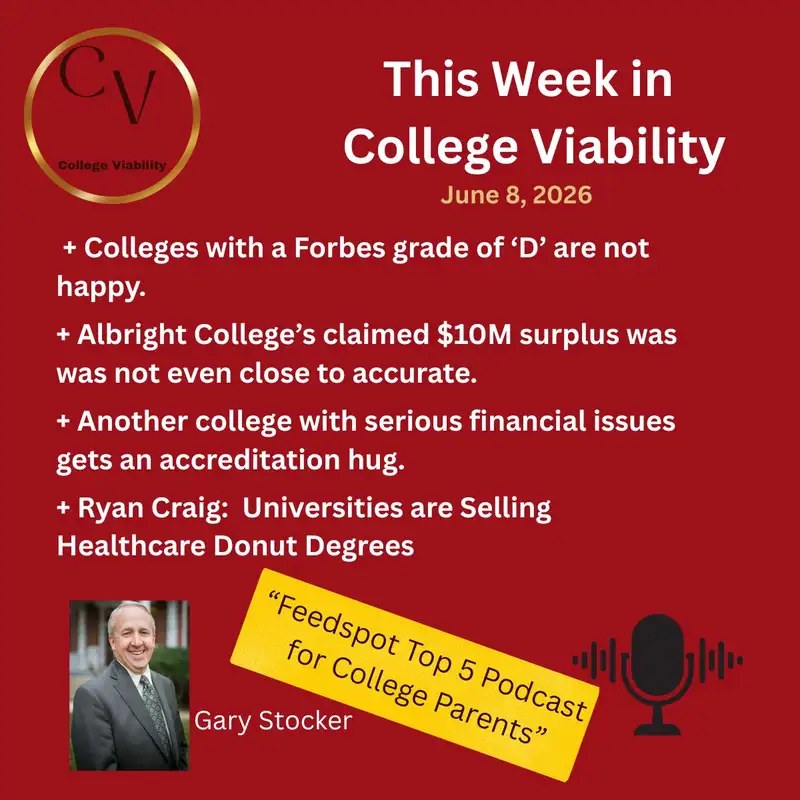
And cutbacks, I'm just gonna start listing most of them without any details to go with them, otherwise it'd take up too much of the show. Colleges that got bad grades D's usually from the recently released twenty twenty six Forbes College viabil
TWICV for June 8 2026 (01:00.462)
Colleges that earned bad financial grades from the Ford's 2026 private college financial grades are trying to argue that the data is not a true indicator. Okay. Okay, we'll talk about that. Albright College, always a frequent flyer here on the show, touted last year, I believe it was, a $10 million surplus. It was actually $4 million plus, a little bit more than that. And most of that was from a non-recurring source.
The I dotters and T crossers strike again.
TWICV for June 8 2026 (01:36.47)
And Ryan Craig has an interesting story on universities are selling health care donut degrees. He calls them, and I'll talk about that toward the end of the show. And again, the products that are out there. The 2026 College Majors Completion app, more than 160 some odd majors over the last four reported years for associate degrees, bachelor's degrees, master's degrees for some 2,700 plus public and private.
Two and four year colleges.
TWICV for June 8 2026 (02:15.242)
And the college viability inspection report available here in the last month or so. We've had that out. It's free. You can get the data, you can get the comparisons, you can look at the green and red colors for your college at no cost. We do have a little fee there at the end if you want some questions to ask your college in conjunction with the data for that college. And of course, the college financial compass that Matt Hendricks at Perspective Data Science developed is available and just released a promotion for that by that compass, $219.
And you get the trustee version of the navigating the numbers. It's a tour, it's a training guide on how to interpret and analyze the data, the financial data for your college, and be able to ask more informed questions to college leaders. And along with that is the 2026 Majors Completion App, the academic leadership version for with five years of data, $219, saving more than $700. Go to the website, I'll have the link in the show notes.
To get those products in that bundle as well. And layoffs and cutbacks. It's just been agony facing a big deficit. The new school begins layoff. Megan Zanese had the story on June 2nd at the Chronicle. And there's details there. I'll have the link in the show notes. Kent State, Colorado State, and other universities turned to budget cuts. And here's the list. Here's what I promised.
Ben Inglesby had the list on his story in higher education dive on June 5th. Kent State University in Ohio to lay off 45, up to 45 staffers. Southern Oregon University plans to plan a Southern Southern Oregon University plan would cut or consolidate 13 academic units. That's a big deal. Bowie State University plans to cut nearly 80 jobs. Colorado State University turns to layoffs and other cuts to manage budget hole.
I've had this one before. Portlet State, Portland, the State University budget plan would cut 52 million jobs. There, the university's American Association of University Professors has blasted officials $35 million deficit production projection and vowed to fight faculty layoffs, of course. And the full story will be available. And finally, deep breath, University of Oregon freezes hiring as it aims to cut 65 million.
TWICV for June 8 2026 (04:39.682)
Dollars from its budget. I had I'll add one more that I just see in my notes here. from Winston Rogers at Fox Five News, over 880 University of Maryland workers laid off amid budget concerns. And if anybody ever challenged me, challenges me that this is a that is this is not a declining industry, what I the list I just gave you is a clear indication that it is.
Week in and week out, there are layoffs and cutbacks and closures on occasion, those will increase. This is a declining industry. There's no way around it. Page two. All right, somebody's gonna push back, of course. Happens all the time. Westminster University, this is the one in Utah. There are a couple others across the country. Westminster University in Utah disputes Forbes assessment after receiving a failing. Well, it wasn't failing, it was a D because Forbes doesn't give Fs.
Receives a failing financial grade. Natalie Wadas had the story on KU TV on June 3rd. The link, of course, will be in the show notes. And this is the second college. I think I posted something on LinkedIn about the first one. This is the second college I have seen challenging these Forbes grades. I expect there to be more. And I understand, you know, when when when consumers, when the market reads that you've got bad finances.
It can become a self-fulfilling prophecy. Folks will hesitate to go there, whether it's colleges or grocery stores or car dealerships or you name it. And I understand it's a self-fulfilling prophecy, and I would be distressed also if I was leading a college that got a bad grade. Yet numbers are numbers. Historical trends beget current results. And as you might imagine, the colleges that earn good grades have no issues.
with the Forbes reporting and the data behind it. And a reminder, this is the college's data.
TWICV for June 8 2026 (06:44.972)
Nobody's searching up this data from independent sources. The colleges submit this data to a variety of organizations and sites. Organizations, companies like Perspective Data Science and College Viability and Forbes, just create useful ways to make the numbers mean something to consumers. And I I noticed, and I usually see this, sometimes they take a shot at the numbers, but I noticed that in particular, the Westminster University, the Utah version,
Their responses were really strong on generalities. We're doing okay. We're fine. Our aroma looks good. And they were really weak on numbers. Students, students, and parents deserve better. Period. And this is why higher education needs independent sources like college viability and others, and even Forbes, to add depth of perspective for students and families. Something like 25% or more.
Of the more than nine hundred four year private non profit colleges looked at earned the letter grade D as in dog.
Forbes, as I said earlier, does not give F's.
If you if if if you don't want to pay for the Forbes subscription and you have a college that you want me to look at for you and you can't find it anywhere else, drop me a note to Gary at college viability. Tell me what you're looking for, what college or colleges you're looking for, and I'll jump in the Forbes report and get that back to you, as long as there's not 10,000 of them. So have I ever gone to the data before? Yeah. So let's go to the data.
TWICV for June 8 2026 (08:26.058)
This is iPad's data, data from the National Center for Education Statistics. Westminster University's Utah version, FTE enrollment has declined for the last eight reported years. That's 2017 to 2024. It has decreased from 2366 to 1091. Do the math, that's a 53% decrease. And for perspective, and Matt Hendrix makes this case all the time, it takes at least four years.
To recover from one bad enrollment year because that freshman becomes sophomore junior senior. Westminster University has had eight consecutive bad years. I don't know, it's gonna take eight times four years to recover from that. Probably not, if they can recover. And since 2021, revenue from tuition and auxiliary fees has dropped from $34 million, $34 million to $24 million. Get your fingers and toes out. That's $10 million.
Since twenty twenty one.
TWICV for June 8 2026 (09:30.988)
Since at least since at least 2021, operating revenues have decreased. Well, operating expenses have increased. That's controllable. And the university's endowment has plunged $21 million from 95 million to 73 to 74 million. You can see, you can see where Forbes grades might be worthy, where the Forbes grades might be worthy of valid consideration and not rationalizing and saying they don't see the inside story painted.
Buy a college with a vested interest and making itself look good. Nothing wrong with that. That's what marketing and communications people do. That's what college leaders do.
And the college is representative in I think it was a news story that I that I watched on YouTube maybe, mentioned the strong four year graduation rates. And they are strong. They are good. They're they're good at Westminster University in Utah.
And however, high graduation rates cannot offset a fundamental lack of market demand. It also concerns me. I've talked about this on the show with Matt Hendrix on the College Financial Health Show. There are too many colleges, like Westminster U that are doing a good job of graduating students, but their financial health is not good. And to me, that's even worse than colleges who can't graduate students and also have bad finances.
Colleges that seem to have a way to graduate students are also, not in every case, but too many cases, are also having financial issues. This is a declining market.
TWICV for June 8 2026 (11:03.758)
And and families, families looking at this college deserve a broader perspective. And at all colleges. Presenting a graduation rate as proof of institutional stability is misleading. Sure, it's good. But if a student enroll today, based on that four year, on that good four year graduation rate at Westminster University, can the college guarantee, can the college guarantee its financial health will allow them
Actually, to allow those students to actually finish their degree at that college over the next four to maybe six years. And I if you want to see the full 15 key majors for for from 2021 through 2025 for Westbur Westminster University in Utah, drop me a note on LinkedIn or s or email me at Gary at College Viability, and I'll send you the data, the screenshot.
Argue if you want against the data, but
I'm here, I'm gonna catch it, I'm gonna point it out. And how about a frequent flyer? And not only frequent flyer, but a good reporter on top of this, Amanda Fries, a Spotlight Pennsylvania, had a story on June fifth that Albright Colleges touted, and they touted this a lot ten million dollar surplus was less than that, more than half less. It was four point million and something.
And
TWICV for June 8 2026 (12:35.084)
I don't even know what to say about these kind of colleges. Their survival is problematic.
They they continue to think that the world cannot survive without them and they are taking advantage of students.
by providing, by not providing a high-quality, properly funded college education, college education, let alone faculty and staff and the communities. Let it go. Find somebody, find the light switch, change it from on to off. And before I go to page three, there are two other podcasts that I want to talk about that I have been producing for many months at College Viability.
Kitchen Table College Chat. Kitchen Table College Chat is with another higher education professional, Mark Debore, and I get together every Thursday. This podcast was created to provide a new and different perspective for parents. More of a detail-oriented admissions process, things to look at, finances to look at for college students and their families. Mark and I, as you might imagine, challenge the conventional messaging, the brochures, if you will, from colleges and give listeners
Some new questions to ponder or to even ask colleges. And then the other podcast that I do by myself is one called Beyond the College Brochure. Beyond the College Brochure does just that. We go beyond the marketing, we go beyond the websites, we go beyond the brochures and the email marketing. And it's it's another podcast, it's another podcast project that takes the college discussion way beyond what college, what colleges market with brochures and websites.
TWICV for June 8 2026 (14:20.81)
It includes Paul Harvey-like stories about colleges. And started actually with a with a college student interviewing me about the college decision process. And those podcasts are still out there. And it will soon include news stories, kind of like what we do on this week, about higher education that will help students and families become more informed about the industry. Both podcasts, all the podcasts, all the media that I do are consistent.
With our themes of increased transparency from colleges for its students and families. I'll leave a link to the podcasts in the show notes and I'll put them in LinkedIn post as well. Page three. LaSalle University. Let's get out the I daughters and T-crossers here. LaSalle University, Pennsylvania. Their accreditation reaffirmed by the Middle States Commission on Higher Education. May 29th, the story was an internal LaSalle release.
Students and families.
We we see yet again why accreditation agencies are not much more than I daughters and T crossers as I tease all the time. When colleges note they are fully accredited, again, moms and dads, students, grandpas and grandmas, aunts and uncles, when colleges note they are fully accredited, it doesn't really mean that much in twenty twenty six. And here's why.
Here's why. La Salle University, Pennsylvania.
TWICV for June 8 2026 (15:51.308)
Has been rating their endowment, which is essentially their savings account. That's a gross generalization I know, to the tune of 7%, 13%, 18%, 20% over the last five years. The typical draw is between four and five percent to be able to keep that endowment steady. And their endowment at LaSalle has gone from 95 million to 58 million, down not quite 30 million, not quite 40 million dollars.
And so to the data we go. I don't know why the accreditors don't go to the data, the financial data. The president there is Daniel J. Allen. He's got two quotes that I want to talk about. In 2024, the university saw a 23% increase in enrollment over the previous year. All right, that's the first one. In 2025, the class made waves becoming the largest group of first time, full time students since 2019. Okay, good for them.
I I can't believe that he doesn't have good data for this. Whatever the source, probably an internal source. Here's what they submitted to the National Center for Education Statistics. Full time equivalent, which is a cal calculated way to give a nice standard measure of enrollment. From 2016, it was 4,211. In 2024, it was 2,447.
TWICV for June 8 2026 (17:21.516)
Maybe from twenty twenty-four it increased twenty-three percent. I didn't see that. Not in the debt I looked at. The total enrollment, two thousand sixteen, five thousand one hundred and ninety-seven. Twenty twenty-four, three thousand one hundred and fifty-three.
And even I th I think he addressed net net steward net student tuition revenue. Now I c I calculate student tuition and fees, which is room and board kind of stuff. And in 2016, it averaged $18,000, almost $19,000 per student. 2024, a little less than $16,500. If you adjust for inflation from 2016 to 2024.
It goes from not quite nineteen thousand to just a little over twelve thousand dollars.
TWICV for June 8 2026 (18:17.518)
The four-year graduation rates are good. Although declining. It was 67% four-year graduation rate in 2016, it's down to 58%. Still way ahead of most colleges. But their finances are not good. Their numbers are not, don't match up with what I have. We compare the data. We use the data colleges themselves submit. The data from LaSalle is from the National Center. It is from
Financial Auto at financial statements. It's from IRS nine nineties. One of us has bad data.
One of us has bad data or one of us is spinning it in ways that confound. Draw your own conclusions. Page four.
I think I've talked about this before. Colleges, the higher education industry is trying to find ways to say we're okay as an industry. And certainly there are hundreds and hundreds of public and private colleges doing just fine. But as an industry, when you look at the big picture, it's not doing fine for all the reasons I've talked about over all the podcasts that I do. And Forbes had a story, Mike Meetso this story on June fourth.
And and I'll share this reminder as we get started. Generalizations, better industry, in this case higher education, do not help students and families choose colleges. And so they're noting here a small increase in enrollment from fall to spring.
TWICV for June 8 2026 (19:55.658)
And in my mind, right or wrong, this is part of a subtle or not so subtle effort by higher education insiders to change the narrative on higher education's obvious decline.
From the story in Forbes, the gains were concentrated largely among undergraduates attending public institutions. Community colleges saw the largest increase, 3.1%. Public four-year universities gained 1.5%, while schools, while colleges in the private sector, both nonprofit and for-profit, saw small undergraduate enrollment downturns or decreases.
And and and and this is consistent with the points I've made all along. Inexpensive and brand name colleges are inching their enrollment up. They're inching their enrollment up. Not so much with private colleges. Not so much with private colleges. The information that students and families need is which of the private and public colleges.
have the financial health to be around in four years or five years or six years.
TWICV for June 8 2026 (21:20.172)
And it's not even the the closure piece that matters.
TWICV for June 8 2026 (21:25.742)
Colleges with with significant financial challenges almost certainly cannot provide the type of quality college education you and I want for ourselves, for our offsprings, or for our communities.
And as we saw with Albright today, with Westminster University in Utah and Loras College, which had the similar denial of the Forbes data, and I posted that on social media. As with these three colleges and others, transparency transparency, financial transparency is not a strength of colleges in trouble.
That is why the college viability inspection report is becoming an increasingly important tool that makes understanding a college's financial health and outcomes and more easier than any other tool out there.
And remember those those other websites that compare colleges.
I think most, if not all, of those college guidance websites generate that generate at least part of the revenue from fees that colleges themselves pay to promote themselves.
TWICV for June 8 2026 (22:39.234)
How unbiased, how critical can your analysis be if you're running a website and your revenue and a significant source of your revenue comes from the colleges that you are listing and comparing and providing data on.
college viability does not use that model. Nobody pays us except you for the tools that we create for you.
TWICV for June 8 2026 (23:06.274)
And finally, universities are selling healthcare donut degrees. Craig Forbes, Ryan Craig had this at Forbes on June 9th. The link will be in the show notes. And so background first my Bachelor of Science degree was in medical laboratory science long, long time ago. 90 college credits at Eastern Illinois University in Charleston, Illinois, and 30 credits for a 12 month internship in a hospital.
In that internship, I had hands-on experience in learning how to cross match blood, identify bacteria and the drugs that would kill them, identify normal and abnormal white blood cells and red blood cells and much, much, much, much, much more. I still remember most of what I learned those forty plus years ago, today, even and I don't use it that much.
My college, Eastern Illinois University.
helped coordinate my medical laboratory science internship placement. There were three or four or five colleges that accepted students from Eastern Illinois University in a formal agreement.
Ryan Craig's article effectively shares, effectively shares how that has changed for way too many colleges. And this is across every nursing and allied health care discipline. And we talked about the laboratory, there's physical therapy, occupational therapy, respiratory therapy, and others. And and from Ryan Craig's article,
TWICV for June 8 2026 (24:36.022)
You know, you say as you know who else is doing nothing. This is a lead-in from a story from part of the article up above that. Healthcare programs that require clinical experience for a degree, healthcare programs that require clinical experience for a degree, but leave students to find it, find that clinical internship themselves. Perhaps universities selling degrees with a hole in the middle.
Can take credit for doing something by doing nothing. He goes on to say, maybe making students more industrious. But like the happy, fiscally prudent couple he talks about earlier, they're just passing the buck. And he goes on, and for the same reason that we have a shortfall of millions of apprenticeships and internship opportunities, and that's Ryan Craig's thing, there aren't enough players, in this case hospitals and clinics and practices, willing and able to do the heavy lifting of onboarding and training and supervising unlicensed.
Learning practitioners. I added the word learning. Now, many from the article, away from the article now. Now many colleges offer a degree in those disciplines, but cannot and do not guarantee clinical internship placements. So a student invests something like three years, and it varies, three years at a college, and runs a risk of not landing the clinical experience needed to graduate and get a job.
So students and families, grandpas and grandmas, aunts and uncles, here is important guidance for those considering these healthcare professions. Dig down deeply at these colleges to find out what past successes and future assurances that college has had in placing students without delays, without delays in their time to degree.
And the rap ties in with this last story as it usually does. The last story about donut degrees tells us much about higher education. Too many, but not all, too many, but not all colleges are taking students money without any systemic assurances that the college can provide all the needed components for these healthcare professional degrees. In my experience, it's relatively easy to set up a
TWICV for June 8 2026 (26:57.474)
Take a combined set of courses you already have and give it a new degree name. You know, my degree in MLS is a perfect example. Biology and chemistry and organic chemistry, microbiology are offered at most colleges. And many have combined those basic offerings with a few other science, probably some math courses. And voila, medical laboratory science degree is born. But to do it right, you have to have the right courses.
In addition to the clinical disciplines. And St. Louis University does it right. Here's some examples. They have courses, didactic courses, academic courses in immunatology, medical immunology, medical bacteriology, hematology, the counting of blood cells, red blood cells, and white blood cells, laboratories in hematology, clinical chemistry plaque practicum, clinical hematology, clinical phlebotomy, they teach you how to draw blood, clinical immunology, cross-matching units of blood identifying antibodies.
These do this is an example of a college that does it right. Too many colleges don't have the resources to offer these courses, but are still throw out these kind of majors. The medical laboratory science is my example. Why? You're not gonna fall out of your chair on this. Revenue. Revenue. But do you do you want yourself or or your child to select a college that does not have a complete
Linear, no interruptions, path or degree. And this is where college viability and our data and our comparisons and our trends and our podcasts and the college financial health show with Matt Hendricks make a difference. We challenge the college brochure and everything behind it. Colleges spin information. Always have, always will. And there's nothing wrong with that. We all do it. But for such an important decision as a college to invest four years, four or more years.
And at least tens of thousands of dollars, getting your information solely about a college from its brochures and email marketing and tours and college subsidized websites like niche.com is risky. Use our stuff. Get another perspective. Get a different perspective. Get a different perspective. And I'm gonna call that a wrap. Let's do it again next Monday. As always, so grateful.
TWICV for June 8 2026 (29:20.142)
For now, two hundred plus episodes of this week in college viability. So grateful for those who listen. Make sure you're not a college make sure you're not a podcast hog and share the link with your higher ed with your higher education friends for sure, but with families looking at colleges. They need to know this information. I'm Gary Stalker at College Viability. We'll be back again next week.