This Week In College Viability (TWICV) for January 19, 2026
Gary D Stocker (00:01.006)
It is this week in College Viability News and Commentary for Monday, January 19th, 2026. Hi everybody. Gary Stocker sitting behind in front of the blue yeti microphone and using the always smooth running Riverside.fm podcast software. And of course, this is the podcast that talks about the financial health and viability of public and private colleges with data and details and perspectives offered
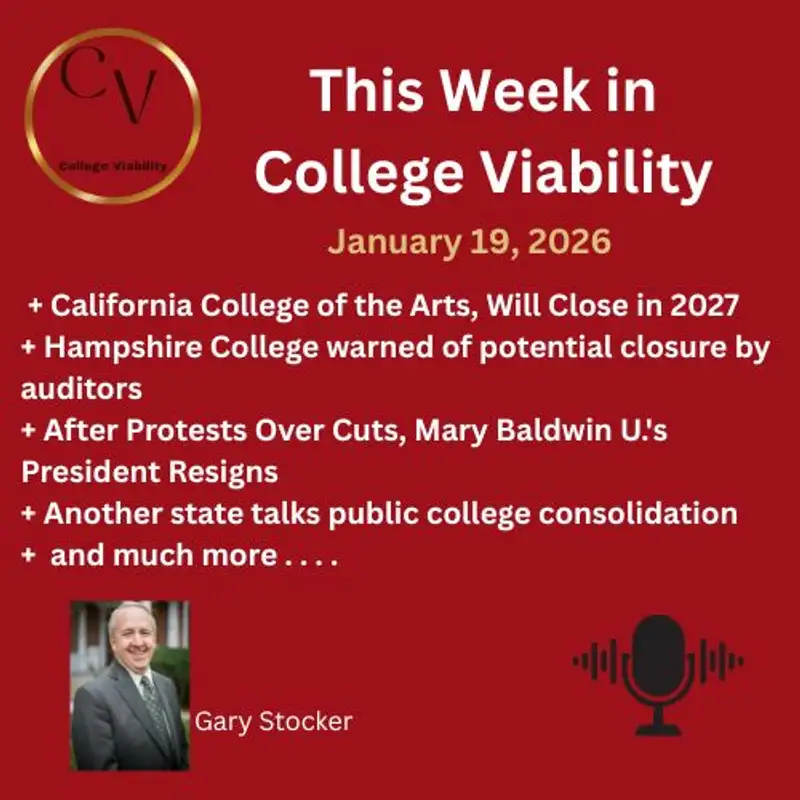
Nowhere else this week, the California College of the Arts will close in 2027. Vanderbilt University out of Nashville, Tennessee is going to take over the physical property there. I'll have details on that. Hampshire College, a frequent flyer on the show, warned of potential closure by auditors. And Mary Baldwin University. They had a president who started last August and is going to resign at the end of this year. I've got a lot of details and commentary on that one.
And there's a company out there helping colleges avoid reinventing the wheel. I'm going to do a quasi promo for them because I think there's value in that. Another state, Oregon, talks about public college consolidation and, of course, much, much more. And as I always do in this time slot on the show, don't be a hog. Make sure to share the podcast link, whether it's on Transistor, Spotify, YouTube, Apple, wherever it is, make sure to share the podcast link with others.
so that they too can have a perspective, a new perspective, a different perspective on the higher education industry. The California College of the Arts in San Francisco will close in 2027. Brian Boucher had the story for Art News on January 13th. And the rest of the story, as the late great Paul Harvey would have said, is the properties had been sold, purchased, acquired by the Nashville University-based Vanderbilt.
University and they will take over that school in 2027. All right, it happens. finances are bad. I don't know that I've had the California College of the Arts on this show before. I don't think Matt Hendricks and I have done the review of that one either. There was an interesting article, though, that came out after that. A couple of days later, Sarah Hotchkiss for KQED Public Broadcasting in San Francisco. Her headline read, What will we lose when California College of the Art closes? I'll read a little bit of what
Gary D Stocker (02:27.276)
Ms. Hotchkiss said, The closure of the California College of the Arts marks the loss of the last remaining independent nonprofit art school in the Bay Area, effectively ending a historic era of specialized local arts education. San Francisco loses a vital engine, Ms. Hotchkiss wrote, with its creative identity as the school's $20 million deficit and 30 % enrollment drop reflect the broader displacement of artists.
one of the world's most expensive cities. Furthermore, while Vanderbilt University will repurpose the campus, the community, the San Francisco community, loses a self-governed institution dedicated to the region's specific artistic legacy, replacing a grassroots cultural hub with a satellite outpost for an out-of-state university. So the tone of the article was in some ways touching. Of course, I'll have the link to the story in the show notes.
In particular, Sarah made note of the fact that the public announcement by the mayor of San Francisco focused more on the Vanderbilt moving there than the closure of the California College of Arts and all the losses that will accompany that. What will be interesting here is to watch to see how the higher education art market, art majors evolves or not.
Will it be through Vanderbilt? Maybe. Will another college or colleges add or expand their offerings to include more art majors? Maybe. Or think about this one. Will artists learn their trade outside of traditional higher education? I would put my money on the last one. University of Texas Arlington offers employee buyouts amid federal funding cuts. We've had this type of story before.
Paul Livingood at WFAA Radio in Dallas had the story. Details will be in the show notes. Some of the incentives for faculty and staff, incentive payout equal to nine or 12 months based salary, depending on the job classification. Vacation payout accrued for unused vacation time, standard kind of stuff for the folks at the University of Texas Arlington. Just one of many doing those kinds of announcements, making those kinds of announcements.
Gary D Stocker (04:51.34)
Hampshire College, again, I said at the top of the show, a frequent flyer on this week. Hampshire College warned of potential closure by auditors. And again, I've got two stories here. Both links will be in the show notes. Maya Shavit for the Boston Business Journal had the story. And Taylor Swack had the story for the Chronicle of Higher Education, both on January 13 and 12, respectively.
Hampshire's been a regular on the show and in general higher education headlines since about 2019. And as regular listeners may recall, the format of Hampshire or Hampshire is effectively pick your own curriculum. It's more nuanced than that for sure, but that's the essence of what it is. All right. So I'm not going to detail the financial parameters. Taylor Schwach did a good job at The Chronicle. She also noted that the new president
New President, always a concerning title, New President at Hampshire was rationalizing in some form the challenges and associating them with a new direct admit program that the college had launched and apparently obviously not doing that well with. So I did look at the financial parameters. I'm not going to share them today. Let me just offer they were the ones I looked at were all heading south. Their auditor, independent auditor.
also indicated that Hampshire might not be able to continue as a going concern. So here is the point I've shared often, and I'm going to share it again and continue to share it. In the larger context of higher education, there are too many colleges and not enough students willing to pay to attend those colleges. In a study I was part of last year, it hasn't been quite published yet, excess higher education capacity, too many seats,
is somewhere around four million seats. Ricardo Aziz was the lead researcher on that. I think it's a higher than that, and it can be a lot higher than that, depending on the assumptions, but let's just assume four million seats. So the president at Hampshire, Jennifer Chrysler is her name, I presume Dr. Chrysler, she remains confident, as she well should, that what Hampshire has to offer is important.
Gary D Stocker (07:13.626)
In a market, she said, increasingly focused on returns on investment and employability, she sees Hampshire's distinctiveness as an advantage, not a liability. She says, you're designing your own course of studies, you're negotiating with faculty on contracts, you're misstepping and iterating and getting feedback. Chrysler said, we can't think of a better real world preparation for a student.
Well, the market, as it always does, is speaking and telling all of us that not enough students want to support that type of education offered at Hampshire. It's obvious by the financials. So bottom line, Hampshire College and countless other colleges contribute, each one contribute to there being too many colleges. Eventually, closures, while not inevitable,
are a reasonable expectation and hope of course is not a strategy. The courage here is in the data and I posted this on LinkedIn, I think it was last week sometime. The courage is in the data and the data at Hampshire College and countless other smaller, mostly non-urban private colleges is not good. And I will offer again, it is incumbent on the leaders at Hampshire and other troubled colleges to look at the data.
and recognize the reality of an unlikely recovery and to do the right things for students and faculty and the communities. Find somebody to turn off the lights sooner rather than later. Page two, Mary Baldwin University. Megan Zanies had this story on January 15th in The Chronicle. After protests over cuts, Mary Baldwin University's president resigns later this year.
and some minors, ones that were cut last November, believe, are restored. So here is from Megan's story. Months of turmoil at a small private university in Virginia came to a head Thursday with the sudden resignation of the institution's president. After an emergency meeting of its trustees, Wednesday night, Mary Baldwin University announced that it will also restore some minors and faculty lines that were cut just last fall.
Gary D Stocker (09:38.842)
Todd Telamaco, who became Mary Baldwin's president last August, August 2025, or talking five months ago, six months ago, will step down at the end of this academic year. So I'm assuming May kind of timeframe for family and personal reasons, the university said in a statement. All right, we'll give them that, of course. All right, sarcasm alert. Colleges will spin bad news just like everybody else.
So maybe, maybe not.
Gary D Stocker (10:14.735)
Todd Telemeko's departure is coming just days before a planned no confidence vote in leadership. And again, there's going to be a book talking about that out in April. I've had more on that in previous shows and I have more on coming shows. In November last year, Mary Baldwin's trustees voted to eliminate 17 minors and six faculty positions to say to do at the time, say to do at the time a line.
Gary D Stocker (10:53.103)
to better align with Mary Baldwin University's strategic direction to focus on career-focused, work-aligned programs, corporate speak, as we all know, and much trauma, followed by faculty and students. And okay, it happens all the time, you've heard me say that. Change the font size. Change the font size on a college business card and somebody somewhere on that campus will protest. Guys, John at Sarcasm Alert again.
It is protests, it can be argued, is what faculty and students may be better known for in many cases than actually graduating. So to the data I will go on Mary Baldwin University 2016-2024 from audited financial statements and the IRS 990s net tuition revenue and auxiliary revenue down over the last nine years four and a half percent. The enrollment was up a couple dozen students.
unrestricted net assets, is essentially the financial value of a college, was down 24%. The endowment value, the gifts from donors,
Gary D Stocker (12:02.393)
Was down 8%. Down 8%. The median in that same time frame for all private colleges, the median endowment value went up 58%. Mary Baldwin University down 8%. That's not good. Because you know what I'm going to say next. Those that follow the show regularly, the endowment draw, the breaking of the proverbial piggy bank.
was a big number in 2024, 20 % was the endowment draw, but typically it's four to 5%, 20 % of a $34 million endowment, you can do the math, well, unless you go to the University of California, San Diego maybe, but that's $6 million and change and Mary Baldwin University, not even graduating 40%, not even four in 10 of their students.
in four years. So big time sarcasm alert.
I am going to take applications for the new president at Mary Baldwin University. Public service, because that's what kind of guy I am. And here are four basic job specifications, job descriptions. Number one, must be prepared. This new president at Mary Baldwin University must be prepared to have every decision questioned and protested. Number two, this new president, male or female,
must publicly acknowledge despite evidence otherwise that the college is in great financial shape. This new president must let faculty vote on everything the president proposes. And most importantly, this president must not change the font size on business cards. I've got a single gish on my notes. This might be worth a double gish.
Gary D Stocker (13:55.684)
five fall 2025 enrollment takeaways. Joanna Alonso had this and inside higher education. The subheading reads, U.S. college enrollment reached pre-pandemic levels this past fall, but despite overall growth, some populations such as adult learners and international graduate students declined. And there was another group that declined. And this news was all over higher education last week.
Gary D Stocker (14:25.485)
And while I don't like generalizations, this generalization news, this generalized news was bad for private colleges. Their overall enrollment decreased last fall. And of course, in Renuka specific colleges, that decrease had much more impact on some private colleges than it did on others. But again, it reinforces something I think is happening as we speak. And I've mentioned this before.
This reinforces my anecdotal observation now somewhat supported by data that there may already be a movement away from financially challenged private colleges to financially more stable larger private colleges and public colleges. Page three, RISE Education. They provide online learning in a revenue sharing kind of format with colleges. It doesn't matter what type of college it is.
And they published a new research report based on a national and independent survey of more than 1,500 high school and college students examining how those students think about online, in-person, and hybrid learning. Here's a couple of insights. 91 % of high school students went at least one online course per semester. 76 went two or more. 74 % of these students, college and high school,
say online options matter in their college decision. 31 % would switch from their top college choice if another institution offered more online options and there's some more data that goes with it. And here's the point I want to make on this. Late last fall, I think it was, I saw a social media post from a small private college in the Midwest announcing with great fanfare
that they were starting online offerings, online courses and majors. I can't remember which it was. A handful, something like that. And here's my point. Rise Education, it's R-I-Z-E by the way, Rise Education has many, many majors and many, many course offerings already available, done by professionals, scaled for use anywhere. They've already invented the online wheel, so to speak.
Gary D Stocker (16:50.593)
And their business model makes that online. We have those online courses, those online majors available to colleges everywhere. Yet college after college, college after college continues to create and tries to market their own online courses. They're competing not just against Rise, but they're competing against online giants. You know who they are and have little chance.
these new colleges, these small colleges just starting or with minimal offerings, they have little chance of generating materially significant new net revenue. So you're listening to this and you're thinking about it or you've started your online stuff and it's just not getting going. Reach out to Kevin Harrington. Kevin Harrington is the president at Rise Education. Tell him that mean old Gary Stocker sent you to him.
and offer your current and new students more and more opportunities. And start generating new net revenue today, not never ever. Page four, how Oregon's top higher ed board wants to solve university deficits, public colleges.
The state's Higher Education Coordinating Commission recommended institutional integration and regular audits of academic programs. Laura Sputnik had this at Higher Education Dive on January 13th. Here's from the story. Here's from her story. Oregon's Higher Education Coordinating Commission last week approved a suite of policy recommendations meant to increase efficiency at the state's seven public universities.
If enacted, institutions would see regular audits of academic programs like we've seen in Indiana, Ohio, Texas, Oklahoma, I believe, and elsewhere. Would see regular audits of academic programs and could face mergers. Report advised all of Oregon's public colleges to collaborate and develop plans for targeted institutional integration. So, here it is again.
Gary D Stocker (19:04.247)
Yet another state looking with public colleges, another state looking at minimum completion numbers for majors, like those states I just mentioned and probably others, and pondering consolidation in some form or fashion. Now, I'm guessing that this week and next I start to see protests from Oregon public faculty. It's inevitable, but it's a pattern.
It's not just happening in Oregon, as I've shared, it's happening and has already happened in other states. Public colleges and universities are consolidating in different ways, different forms, different fashions, usually with accompanying protests, but it's happening nonetheless. So for those of you in the private sector, take note. You will almost certainly fall behind if you haven't already started substantive internal conversations.
about mergers. And as you've heard me say before, not mom and pop mergers of two colleges. I still believe, strongly believe, that large scale mergers, something like 10 or more colleges, will be necessary to be competitive and to get the cost scale where it needs to be. And I don't normally do this, but that's in addition to offering presidential job specs. Drop me a note, gary at collegeviability.com, and I'll set up a brief Zoom for anybody.
And I'll spell out for you the logic behind my thought process about larger scale college mergers. I can even use my data sources that I have access to and that I've created some to help you spec out colleges with sufficient financial resources to be a good merger partner.
Gary D Stocker (20:56.185)
So let's do a wrap. There have been many, many 2026 predictions of more mergers in higher education, I just talked about. And while there almost certainly will be some, I still believe it's too early for the big numbers to hit. And the historical dragging of the feet in higher education, mostly by faculty,
suggests to me that more trauma, more industry trauma associated with closures and layoffs needs to occur first. There is a tipping point out there. Not sure what it is or when it is. There's a tipping point out there when colleges, mostly private, will move much more quickly to merge. just, I still don't believe as much as I do this stuff, as much as I research this stuff, as much as I talk about this stuff,
I just don't believe 2026 is the year.
And as Matt Hendricks looks at private college runways on our Tuesday College Financial Health Show with Matt Hendricks and Gary Stocker, he regularly notes that many colleges, many private colleges, that's all we do on the show right now, many colleges still have some financial runway. And he's right. And when colleges, though, when colleges, even those with some financial runway, a couple of years, two years, four years, five years, something like that. But when colleges look out and see the end of the road,
quickly approaching, there will almost certainly be incentive to move forward with mergers, even with protests, even with bad signs walking across your campus.
Gary D Stocker (22:44.629)
It's inevitable. That's what other industries have done and it is inevitable in some form or fashion in higher education. thanks for listening. As always, I'm grateful for those listening on all the different mediums that you go to. The download numbers for the podcast continue to grow nicely. I'm so grateful. And so until next Monday, I'll be back with another episode of This Week in College Viability. I'm Gary Stocker at College Viability.