This Week In College Viability (TWICV) for Jan 26, 2026
Gary D Stocker (00:01.16)
It is January 26th, 2026. And of course, time for yet another podcast episode of This Week in College Viability News and Commentary. Hi, everybody. Gary Stocker sitting behind these cold and snow covered blue Yeti microphone and the Always Smooth Running Riverside FM podcast site. Of course, this is the podcast that talks about the financial health and viability of public and private colleges with data and details. And I believe Perspectives offered
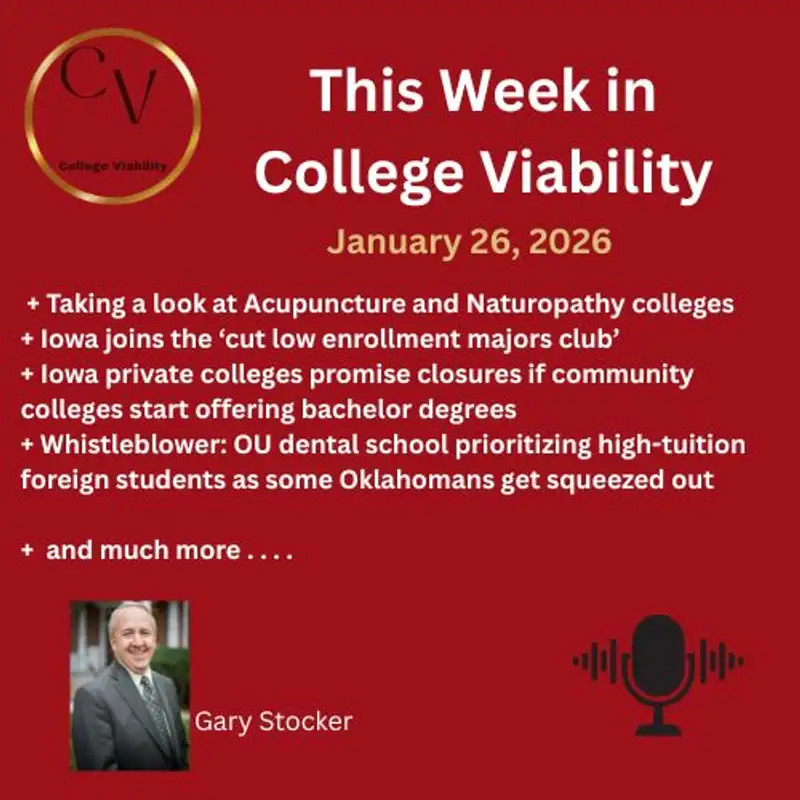
nowhere else. Where are we going this week? Going to start off with something new. We're going to take a look at acupuncture and naturopathy, natural medicine colleges. I haven't done that before. I've got some interesting perspective on that. Iowa is a regular this week. Got two stories on Iowa. Iowa, the state of Iowa, joins the CUT Low Enrollment Majors Club. I'll talk about that. And Iowa private colleges promise closures. The promise closures if community colleges start offering a bachelor's degree.
My bachelor's degrees, I've got some extended thoughts on that and the good folks in the public colleges in Oklahoma. Really looking to drive revenue, it looks like. There's a whistleblower report that the OU Dental School is prioritizing high paying tuition foreign students as some Oklahomans get squeezed out. And as always, don't be a podcast hog. Make sure to share the podcast link with your friends and family, higher education colleagues. No sense in just you.
getting the latest news and commentary on the whole industry. Layoffs and cutbacks while we're staying in the Midwest today. Wichita State, Kansas. The Wichita State budget deficit is now expected to be 7%. This story comes from Cammie Steinle and Cass Lewis at The Sunflower on January 24th. In a January 20th announcement to Wichita State staff, it was announced that due to lower enrollment and lower funding,
There were going to be some cutbacks. Vice president of academic affairs and provost Monica Loonsberry has confirmed that vacant faculty and staff positions will continue to be left empty in order to reduce workforce expenses. Same kind of story we see over and over again. Cutbacks, layoffs, and closures. Big, big part of higher education in the 21st century, the middle part of the 21st century. Page two, Ryan Hofer at SUBSTAC.
Gary D Stocker (02:27.584)
He's got a posting, a lot of them, but this one's called Debt. This podcast, his sub stack page is called Debt, D-E-B-T, Debt by Natural Causes. And I'm going to reference a story he had last week, I believe it was, entitled No Now With More Apocalypse, in Apocalypse, Musings on Doom. This was on January 23rd. And I'll have the podcast, the sub stack link in the show notes.
Put this in context, acupuncture and neuropathy, also known as alternative medicine, in the context of the big, beautiful bill and its changes to loan amounts and post-degree earnings. All here's a quote, a couple of quotes from Ryan Hofer on his Substack podcast, his Substack show.
Things are looking extremely bleak and it's because the extremely bleak financial reality of alternate medicine graduate degrees is finally receiving scrutiny. This is from Ryan Hofer. A legal challenge seems likely to me, associated with the big, beautiful bill, since effective, since affected programs might as well try a Hail Mary to preserve their financial lifeline. Probably what it would be.
He says, I doubt the publication of data on the official Department of Education website will be halted. So everyone will be able to see the terrible financial outcomes. So everyone will be able to see the terrible financial outcomes of alternative medicine degrees. So his point he goes on to say is that alternative medicine institutions are on shaky financial ground. Students are the one shouldering the risk, the financial risk. And he says this situation is wrong.
It's wrong, Ryan Hofer goes on to say, it's wrong for students to be recruited into extremely risky environments when they don't understand what is going on. When a school closes in an orderly fashion, staff have time to look for a new job and apply for unemployment. Assets can be sold, fund liabilities and severance packages students, Mr. Hofer contends, on the other hand, get their entire life thrown up in the air, incomplete degrees, lifelong debt and much.
Gary D Stocker (04:45.75)
He goes on to conclude, I don't think this is Ryan Hofer. I don't think most alternative medicine programs will last past the year 2027 through 2028, even if they can adapt to the July 2026 loan caps and the July 2027 earnings tests for transparency. Now, Ryan Hofer writes a lot and I mean a lot about alternative medicine colleges. He and I have spoken a few times.
I'm working on getting him on the podcast sometime soon. And his general theme, like he just referenced, his general theme is these alternative medicine degrees cost too much and those who earn the degrees have actual income levels well below what those colleges promise.
Now I'm going to make the caveat, a buyer beware argument. I've done that before, not always with great success because others have pushed back and says, Hey, students aren't able to research the financial health of colleges easily. And in some ways they're right. But of course, that's why I'm here. I take that data. I make it easier. I'm going to talk about a new product here a little bit later on in the podcast. would, they're probably right in some degrees and they're probably wrong.
some degrees when they're pushing back on that caveat emptor argument that I make. But I would offer a rebuttal, a tender rebuttal, that these same students take great care and research in choosing their clothes and cars and phones and food and what else. And I understand those are comparatively simpler purchases. It appears reasonable that the big beautiful bill changes will have an unintended consequence
of making it harder for students to select some majors because of loan limits and colleges will have to pull back from degrees with weak earnings history. This applies to all majors at all colleges, but this alternative medicine education industry appears to be in particular trouble. To Iowa, we shall go. The University of Iowa considers cutting low enrollment majors.
Gary D Stocker (07:00.77)
Now, low enrollment is different than low completion. So I track on the 2026 College Majors Completion app, actual majors completions. Low enrollment is different. The Iowa Board of Regents has identified a list of programs that could be removed because of low enrollment numbers and a lack of long-term viability. This is from ABC9 in Cedar Rapids, Iowa. Connor Woodruff had the story on January 17th. Mr. Woodruff writes the...
Regions consider low enrollment to be undergrad programs with fewer than 25. I would guess that would be across four years. And grad programs with fewer than 10. I'm guessing across two, maybe three years. For the University of Iowa, for example, majors like applied physics, religious studies, gender, women's studies are considered low enrollment undergrad degrees. There were 13 total undergrad degrees listed, some with fewer than 10 students.
One had three students counseling and behavioral health sciences. For graduate programs at the University of Iowa, film studies, orthodontics, and nursing practitioner are among the 16 programs considered low enrollment. All right. It's happening. This isn't the first time I've had a story like this. It is happening. Publics by mandate are cutting back on low enrollment, low completion. Majors by mandate are being told to by their governing bodies.
Privates not quite there yet to what I can find, what I can tell, but privates will inevitably be doing this out of financial necessity. They just cannot reasonably expect to be everything to everybody. And they will cut majors, cut programs with low completion or low enrollment. And here's kind of a different perspective though. Through this all, there will be opportunities.
for some colleges to identify weekly enrolled majors.
Gary D Stocker (09:00.768)
and maybe roll 10 or 20 separate programs into one.
My 2026 College Majors Completion App will be a resource to help guide those decisions. It'll be out the door, I hope, later this week.
a couple merger and acquisition studies. The governor of New Jersey, Governor Murphy, signs the law advancing the Kean University and New Jersey City University merger. That's a public one. That story was on January 12th in Insider and J. I'll have the link in the show notes, of course, and Morningside University, Iowa. Morningside University and St. Luke's College complete the first stage of their acquisition. Those are two private colleges.
Brooklyn Drazee had the story at KCRG, ABC TV and Sioux City, Iowa on January 19th. And so yes, a private college merger. We don't see those often. Morningside and St. Luke's College, St. Luke's College is UnityPoint Health, are starting off 2026 with efforts to begin melding the campuses together. Having announced in the summer of last year,
that St. Luke's will eventually become a Morningside location. So the story, and I have the link in the show notes, of course, the story has many details of the merger, not important for the podcast. Morningside University presents an okay but not great financial profile. Total operating revenue is down a fair amount from 2020 to 2024. And many indicators are flat from 2016 to 2024, not good, not bad. On the other hand, St. Luke's
Gary D Stocker (10:41.41)
St. Luke's College, UnityPoint Health, has very little data that I could find. They're not submitting data they should through financial statements to iPads that I can find. And I don't know what the story is behind that. It concerns me. The college has less than 100 full-time equivalent students. And maybe the good folks at Morningside recognize this. Maybe this is a merger based on name. St. Luke's College
health, UnityPoint health, and on physical assets that St. Luke's College may have, although with 100 students, I can't imagine that there are a lot of physical assets there. I'll keep an eye on that story, of course. three. All right, here's a way to get a headline. So Rachel de Gadeci, I'm doing the pronunciation guide on my own. I asked her for guidance last week and didn't hear back. So Gadeci is what I'm thinking it is.
She has a headline at MSN.com that a quarter of US colleges would close in the coming years. University president warns of major transformation. And again, details in the show notes with the link. And I don't remember the college president's name. You can look it up. It's in the notes. It's in the link. Well, you know, like I said at the lead, it's I guess this is an easy way to get into a Fox news story. Dartboard economics like this.
making grandiose statements don't really help individual students at single colleges. It just doesn't. And again, that's why I'm here. That's why I provide the data that lets users, consumers avoid that caveat emptor, gives them tools to recognize them, be aware as a buyer that there are financially challenged colleges. I'm never ever, ever, ever gonna say a college will close.
I will share the financial challenges. On occasion, I have said this is probably a college not worthy of consideration. And again, the college transparency tool is ready right around Valentine's Day this year. It's going to provide students and families with a new resource, a better resource to look at colleges, more details on that soon. Back to Iowa we go. Taylor Collins, I'm sorry, Vanessa Miller had this story at thegazette.com. Iowa private colleges.
Gary D Stocker (13:10.254)
promise closures if community colleges start offering bachelor degrees. Representative Taylor Collins promises to advance four-year degree legislation for community colleges. So this falls, you can guess by the headline, you can guess by the title, this falls into the news category of fight, fight, fight. Community colleges want to offer bachelor degrees and justifiably, private colleges have a great fear of that happening.
and its impact on their financial health and viability. It makes sense. They can fight all they want. We're just going to report on it here. The big picture view, though, the big picture view is here is what happens if community colleges in Iowa, and it's already happening in other parts, in other states in the country, if community colleges in Iowa and other parts of the country continue to increase, continue to increase the number of majors and bachelor degrees offered.
I think what will happen is each state will build on the momentum of community colleges from other states to offer these programs. Best bet here in late January, 2026, best bet is that politicians will be mostly supportive of those public entities offering bachelor's colleges. So of course the impact on private colleges is not good, but again, looking beyond that, if that were to happen,
As more private colleges close, and they're going to close whether community colleges pick up bachelor's or not, as more privates close, community colleges will have more opportunities to add more majors, add additional majors, and even scoop up the faculty from closed private colleges to teach those new majors. Think about that for a moment. Page four, Oklahoma.
They're running a business, I understand that. But there's a whistleblower there that says the OU Dental School is prioritizing high-tuition foreign students as some Oklahomans get squeezed out. Ray Carter at the Oklahoma Council of Public Affairs had this story on January 21st. Link in the show notes. So the focus here is on OU's Dental School Program. Here is some from Mr. Carter's story. In recent years,
Gary D Stocker (15:33.954)
The University of Oklahoma has significantly increased its reliance on out-of-state and international students.
These students will be charged significantly, who can be charged significantly higher tuition rates than Oklahoma students. For the last two years, the majority of OU's freshmen class has consisted of non-Oklahomans and out of state and international students. And they've accounted for something like 70 plus percent of freshmen enrollment growth since 2014. practice, Mr. Carter writes, in practice, means, that means many American students.
are turned away even as a growing number of spots are reserved for foreign-trained students each year. Again, context is OU Dental School. This is from the whistleblower. Because demand for these dental school slots far exceeds the supply of slots available, U.S. students may have to apply to the OU program multiple times across several years before being admitted, even if they are admitted at all.
And once U.S. students are in the OU Dental Program, international students can indirectly detract from the quality of instruction that other students receive, this is according to the whistleblower, due to language barriers and lower quality preliminary training in some foreign schools. Lower quality preliminary training, the whistleblower said, foreign students often take up a disproportionate amount of OU instructors times.
which has a negative impact on training for US students in the program. I gotta guess there's a lot of subjectivity into that assessment. I can't believe everybody's counting the amount of time instructors spend with foreign students. It's clear to this whistleblower has an edge they wanna get off of and that's fine, they're entitled. So, OU of course, as you would expect, OU defended the practice and indicated that plans are to increase enrollment opportunities for domestic students. Of course, they would say that.
Gary D Stocker (17:40.717)
And this is not the first time that OU has popped up on this show's radar. There appears to be a concerted effort at OU to drive revenue and nothing generally wrong with that, except of course, it's a publicly funded university. It is at best a bad PR look, even if it is a good and successful financial tactic. And like all good things, here's something else to think about.
Like all good things, other public universities will almost certainly copy the OU model. And it begs for now the rhetorical question, when does this become a national issue?
And let's do a wrap going back to math and something a podcast show I posted on beyond the college busher a couple of weeks ago. There's a plot out there. All right. Conspiracy theory coming up here. There's a plot out there to make six, make six equal four. And of course, I'm talking about graduation rates, six years versus four years. Over the weekend, as we were finishing up our product review of the new college transparency tool, I went to the site niche.com, niche.com.
It is effectively a marketing resource for colleges. For colleges, for colleges here. It's a marketing resource for colleges. Yet it calls itself a site that can help students find colleges. All right. I'm not going to argue with the premise. Their primary source of income, though, at niche.com is not students. It is the fees they receive from colleges. They also have programs from something called Niche Direct Admissions, and they also sell leads from students.
going to their site to colleges so they make money. nothing wrong with that. But it begs the question, it begs the question.
Gary D Stocker (19:32.557)
of how transparent is niche.com about colleges with low enrollment numbers, with weak completions in given majors or anything related to the financial health, good or bad, of colleges. They don't. Not that I can find. And I will use this graduation rates to make my point. The niche.com website lists in quotes, graduation rates, two words, graduation rates. It does not indicate that the data provided is for
Six-year graduation rates. Not four years, but the graduation rate is for six years, and they don't say that. Of course, that makes a college look better, six years to get something that should be done in four. And the data points don't reference the year it was measured. It doesn't show a trend of either increasing or decreasing or flat graduation rates. It's a single point in time at the most convenient number for colleges.
Gary D Stocker (20:33.942)
And just think about the opportunity costs from four years to six years. I've talked about that before. I'm not going to do that today. And this is a point that I've raised previously. Colleges, through their investment dollars in allegedly, I can go with that, in allegedly independent college websites, are trying to move the expected graduation rate expectation from four years to six.
ears and they're not being transparent at all and I don't know that anybody has picked up on that besides me. I'm guessing others have. I just haven't seen it. So the new college viability college transparency tool out again around around around Valentine's Day will be our effort to serve as an unbiased continuing effort really our continuing effort to serve as an unbiased independent transparency tool transparency app.
for students and families. We'll charge a few bucks, 50 bucks for the app, but this version is not only going to step students through the decision process of which college by being completely transparent, we're not getting any fees from colleges.
Gary D Stocker (21:49.684)
We'll look at four and six year graduation rates. We'll look at financial health. We'll look at viability. We'll look at enrollment trends and more. And we've designed a tool that will help students and their parents make an informed decision about whether college is even the best choice for them. We're not assuming college is a good choice. We've developed a tool to help students look at that with cost and income. And you'll see that in the college transparency tool very, very soon.
Transparency is a big deal. Talked about a lot. Transparency is a big deal in higher education. Sites like niche.com and other college selection sites may proclaim, they may proclaim transparency.
But there is evidence that transparency is that that transparency is limited and it's limited to making colleges look good with no critical assessments at all, as you'll see on the college transparency tool and other products and media that we do here at College Viability. Hey, that's enough for a cold, cold January 26th, 2026. Thanks as always for making time to listening. Make sure to share this podcast link with your friends, family, and higher education colleagues.
Until next Monday, Gary Stocker at College Viability. So long for now.