This Week In College Viability (TWICV) for Jan 12, 2026
Gary D Stocker (00:01.166)
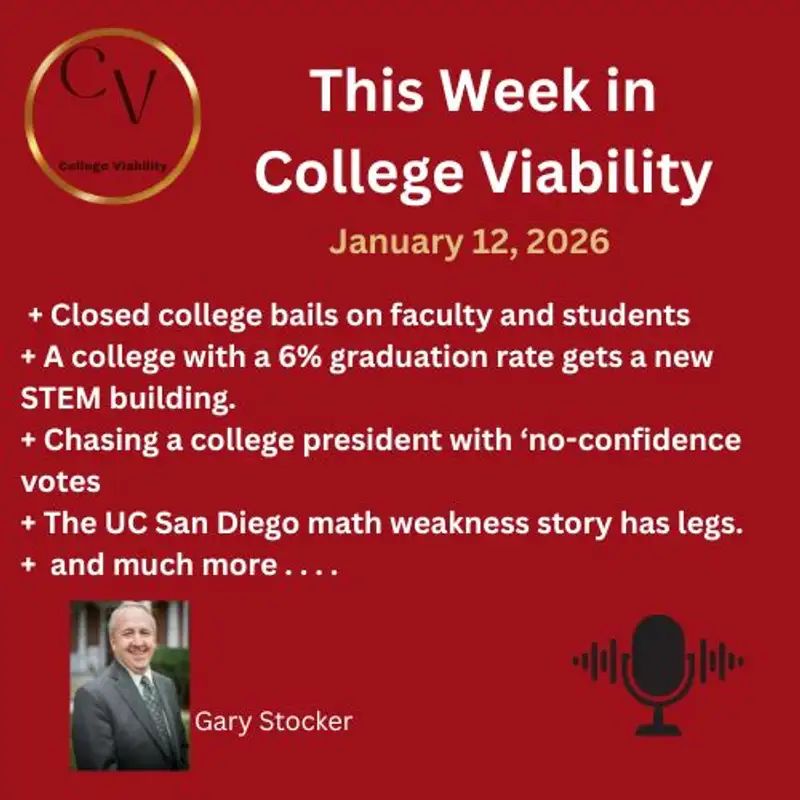
It is this week in College Viability News and Commentary for January 12th, 2026. Hi, everybody. Gary Stonker sitting in front of that blue yeti microphone and the always smooth running Riverside.fm podcast software. This week, we're talking about a lot of different things. We're going to talk about a closed college that bails on both faculty and students. Don't want this to happen to you. We'll talk about universities cut over 9000 jobs in 2025.
I just suggest the trend we've already talked about. And how about a public college that graduated 6 % of its students in 2023, just 6%, getting public funds to build a multi-million dollar STEM building? Ugly stuff. is there, here's something I'm saying, is there a coordinated effort by some, by some in higher education to write stories trying to deny that the industry?
is in decline. And as always, don't be a hog. Share the podcast link with your friends in higher education, with those in your orbit who are looking at colleges for 2026 and beyond, or even those at a college right now who just have some concerns about financial health or other factors as well. Feel free and I encourage you to share the podcast link with one and all. I'm starting off with College Dribble today. Of course, dribble is silly talk.
And here's the quote, believe, I believe in the transformative power of higher education. And I look forward to exploring opportunities on the horizon that will enable me to elevate mission and purpose in support of student success. This is from a college president who just resigned after a no confidence vote. That's some highfalutin words. That's some really highfalutin words, but we see that a lot.
in higher education and let's move on layoffs and cutbacks. Here's a quote from a student. I've had these stories before. The headline reads, now I have to start over. Students are left in the dark after Martin University closes. Jaylen Coleman was in the story. She was a graduate student in Martin University in Indianapolis who completed all of her credits and was getting set to graduate with her degree in May. And the story comes from WTHR Channel 13 in Indianapolis.
Gary D Stocker (02:27.34)
Matthew Foltz was the reporter on January 6th. And here is the lead up. I quote, following the decision to pause operations from Martin University, the Higher Learning Commission directed the university to cease operations. Well, good for the HLC being all over that one. Combined with the lack of sufficient operating revenue, Martin has had no choice but to move toward closure, reads the statement.
Gary D Stocker (02:56.366)
How many times, how many times have I pointed out these accreditors are a day late and a dollar short and they have no incentive or little incentive to cite financial health issues with colleges. And we know the conflict because these colleges pay their fees to the accrediting agency. I won't go into that today. So here is the story from Jalen Coleman. I never got an email. You had to know people for you to know that they, the college were even closing down.
Not going to lie, she said, I cried all night yesterday because like I was done and now I have to start over, Coleman said. A spokesman for Martin University said they had a two day transfer fair in December with other schools for students to attend. Jalen Coleman said she never got notified about it. She goes on to say, I pretty much begged Martin for like three months to transfer my transcripts.
They never got sent. The university that I was trying to go to never received anything. They reached out to Martin on their own and they didn't get anything. I reached out and I never got anything from Martin, Coleman said. And Coleman went on to say in recent weeks, he's tried to reach staff at the university. I want to do now, but has not heard back. I'm not getting any response from anybody.
And then people are saying, talk to the board of trustees and different things, but no one is really giving me an answer. You're getting the run around or they're saying they can't say much, but there's no staff to even communicate with you. there you have it yet again, a college in obvious financial distress for a long period of time. Look at the data in my app, look at the data in Matt Hendricks Financial Compass.
It's been this way for a long time. And it's a credit or the college, the higher learning commission appears to have not done anything until the college itself announced a pause. That was in mid December, I believe a pause. Creative. I'll give them that students, faculty, staff, and community are left to sort out the mess. It appears they're sorting out that mess on their own. And that, that's why
Gary D Stocker (05:26.252)
Your first criterion in selecting a college, especially a private college, should be to look at, assess, and compare its financial health. I'll have a link in the show notes to get you access to a free trial, free trial for seven days of the college financial health report. If you like it, it. If you don't, at least choose it for the seven-day free trial period to check on colleges you are attending or are considering attending.
Juliet Shuman Hall at yahoo.com had a story on January 6, struggling Western Massachusetts College misses enrollment goal by half. And this is a story that we see all the time from colleges across the country. just, and the consequences are substantial. The details aren't important because they're similar to what I've talked about and other colleges have reported as well. Let's go on to universities, cut over 9,000 jobs.
Fox News had this story, Rachel Dougadice had it on January 8th. Universities cut over 9,000 jobs in 2025 as Trump targets federal funding.
The new report from Inside Higher Education, which is the original source, says the university system is bleeding jobs. We talked about that all year in 2025 and even 2023 and 2024. I lead off each podcast with layoffs and cutbacks. The report published Tuesday found that higher education found out that the found that the higher education sector lost 300 jobs in just December and over 9000 in 2025. And there are a lot more details in this story. Again, as always, I'll provide the link.
for you to look at. It's another nail, another nail nailing that industry coffin closed for many, not all, for many colleges, those without the financial resources to provide quality college education. Page two, a frequent flyer on the show, Rider University. In New Jersey, Rider University creates a $2 million hope fund, a hope fund.
Gary D Stocker (07:36.622)
That tells us a lot. Hope fund to help students pay tuition as the college faces cuts and layoffs. And this is a story from Mike the Chance. What's the source on that? I don't see a link on that one. He's quoted as saying, the college writer allocated these funds entirely to provide immediate financial support for students whose education may be at risk due to unforeseen financial or family hardships.
All right, $2 million. Is that too many now? I don't think so. Is it over time? That's what the story suggested. To the data we go in 2024, they had unrestricted gifts, essentially cash, that's a generalization, but that's effectively what it is. Unrestricted gifts in 2024 of 2.8 million. I remember that number, 2.8. Fundraising expenses, and this is from Matt Hendricks, Financial Compass and the Audited Financial Reports. And of course from 990s.
they had fundraising expenses of $2.3 million. So $2.8 minus $2.3. Let me get out my fingers and toes. That's $500,000 in cash, unrestricted gifts, $500,000 net. Now, I've learned you want to look at other areas, and you could also use gifts and grants for operations, which are essentially restricted gifts, is my understanding. And that number was $5.3, which took the total gifts to, it looks like, $9.1 million for expenses of $2.3 million.
The unrestricted GIFs are available for any kind of use. Restricted GIFs, of course, have strings attached. Here's why I point this out.
The data is out there to challenge what colleges are saying. In this case, it's Ryder University. Week in and week out, it's different universities. So college leaders.
Gary D Stocker (09:27.438)
Public relations pieces, talkers, as I have said many times before, spin the data any way you want. This is America. You can spin the data any way you want. It's possible that there is $2 million in this scholarship. I don't believe that's the case. That's the case. But we do financial transparency here at College of Viability. We do it with actual data. And college leaders, if you're taking liberties,
If you're taking qualifications, making qualifications, I'm going to point it out. Not every time. I can't catch them all, but I'm going to point out the ones that I find. And I have search engines tracking this stuff for me day in and day out. And feel free, feel free to take the chance that nobody listens to this podcast. I can tell you, though, I wouldn't be doing it if I didn't get results. Hundreds, of folks do listen to this podcast each and every week.
7,000 downloads in 2025 just on the main distribution arm. And it doesn't include listeners on Spotify that I use, on Apple that I use, and on YouTube that has another 4,000 plus listeners in 2025. So you know what mean, that's fine. That's fine. But the data's out there. And if I'm not sharing it, somebody else is. This is, as I said so many times, the moneyball era in higher education.
Spend data at your own risk. Harris Stowe University, St. Louis. This is a story from the St. Louis Business Journal in October of last year.
Kate Marijalovic had the story. And Heresto plans an 82,000 square foot STEM building, science, technology, engineering, and medicine, math, one of those two. The building will include 12 research labs and a 600 person event space, three stories across the street from what I'm going to call a prestigious university in St. Louis University. They have some financial issues, but they're a strong university. And Heresto is across the street from St. Louis University. And for those of you that
Gary D Stocker (11:36.707)
that follow the show regularly. live in St. Louis and I've been in that area many, many times. And so these spaces, this STEM building is dedicated for labs for biology and chemistry and physics and at least six classrooms. It hasn't been built yet. It's just being designed. Plans for the third floor event space so it can be divided into classrooms. The building is also slated to have offices, study spaces, a cafe, and most importantly, he says, with great sarcasm, a catering kitchen.
It's unclear how much the building will cost. A university spokesman declined to comment. Always fun. So to the data we go. Get out your pen, get out your paper. Harris Stowe University in 2023. Graduated six percent. Six out of every one hundred. Sixty out of every one thousand students who started there. Six percent.
And that was the highest reported percentage since 2016. The numbers prior to that were lower than 6%. And the six-year graduation rate, 19%. So after six years, not even one in five students who started at Harrisdale University graduated. Now I understand there are qualifications or reasons it's an HBCU. I understand that.
Gary D Stocker (12:56.553)
But those are really bad numbers. And the enrollment is down from 900 students down about 200. They don't award master's degrees at Harris Stow. And they're going to build a STEM building. They're going to take funds. I think some were donated. Some funds are donated. They're going to take funds, looks like some state funds, to build a STEM building. No idea what the cost is. And so let's, to the data, we must go again.
I'm going look at external market share in just Missouri public and private colleges. Harris-Stowe, again, Missouri public and private colleges, 2023 is the data source. Biology, external market share, Harris-Stowe, 0.5%. Chemistry, 0%. Engineering, 0%. Math, 0.1%. Physics and statistics, 0%.
They had 10 computer information system students and they had, think, 20 biology and physical science students. Their biggest majors at Harris Stoke University, criminal justice and corrections and some business programs as well. So if you're a Missouri taxpayer or a reporter, this is a story you might want to keep an eye on. Is this really is this really the best use of either tax or even education dollars?
and a college that only graduates six out of every 100 students.
Your call. And over the last couple of months, I've had this math story out of University of California, San Diego, and Brian Legada had a post, I believe it was on LinkedIn a couple of days ago. And he referenced the same Wall Street Journal article that I had when I was back in November or December. The link will be in the show notes. And the core claim is a significant number of students admitted to the elite university campus, University of California campus, San Diego can't
Gary D Stocker (14:58.38)
do cannot do basic math. We're talking fractions, percentages, and simple algebra skills that should be mastered long before college. This isn't speculation. It's based on the University of California San Diego's own placement exam and faculty reports. Now, the Wall Street Journal's argument isn't that these students are lazy or that they are incapable. It's that the system, the education system failed them.
and I think they're talking high school, middle school kind of systems. It's the system that failed them. And the column points to several causes.
The University of California at least San Diego is dropping the SAT, ACT requirement for math, removing one of the few objective measures of math readiness. There's a heavy reliance on high school grades.
which vary widely and are often inflated is the general perception. And if there's a broader shift in K-12 math education away from fluency and fundamentals, yet these students at a relatively prestigious college in California, you see that San Diego are getting in. And I made this point and this Mr. Legati, same thing.
He says the writers argue that the University of Cal San Diego prioritized access and equity. Get them in in equitable numbers. Without ensuring academic readiness. And that this actually harms students under prepared, under prepared freshmen end up in remedial non credit classes they still pay for struggle and gateway STEM courses and are more likely to drop out of their majors or have a delayed.
Gary D Stocker (16:48.514)
And I've said this before, I'm going to share it again from the same article. Their bottom line, Wall Street Journal is blunt.
Access without preparation isn't opportunity. Getting in doesn't just cut it. You've got to have the academic skills, you have academic preparation, and in many cases, some financial capacity in whatever form or fashion to be able to survive. Lowering standards doesn't help students succeed. It sets them up to fail while quietly watering down what a UCAL San Diego in this case
what UCAL San Diego degree is supposed to represent.
And whether you agree with this or not, it raises an uncomfortable question. And that question is how can a highly selective public university admit students who aren't ready for college level math, who aren't ready, who are not ready for college level math and pretend that's being compassionate.
Page three, after a no confidence vote, the University of Nebraska chancellor is to resign. I had this story I think a little while ago. Mike Nitzel had the story in January 5th article at Forbes. And just a sidebar, Mike Nitzel and Chuck Ambrose have a book coming out in April about the history impact and responses to college faculty no confidence votes for their leadership, presidents and boards typically.
Gary D Stocker (18:24.954)
and the president at University of Nebraska-Lincoln, Rodney Bennett, had initially recommended the elimination of six programs, and I had them in the previous story, I won't read those now, and of course faculty created stiff opposition. And they even had a consultant that says, no, you don't need to do this.
And the chancellor stepped down because of the pressure he faced in trying to change things, right or wrong, in trying to change things, the faculty didn't want to even talk about it. They got together in whatever building and room they have and they said, niet. They said no. They said nada.
to keeping confidence in Dr. Bennett. And I'm not gonna pretend to assess the details here. Number one, they bore me and I see them so many times. The bigger picture point is that a college leader proposed to do something.
to financially do something, to cut programs and courses. And we have seen this, I've talked about this many times. And the uproar, as we almost, almost always see, was immediate and fierce. So now what do other college presidents think when they have to ponder, when they have to ponder adjusting their business model and operations?
in the face of financial realities and they have to look at cutting faculty, staff, services, programs, majors. They're going to be scared. They're going to be scared to professional death that their fate will be the same as University of Nebraska Lincoln Chancellor Rodney Bennett.
Gary D Stocker (20:07.096)
Courage, ladies and gentlemen, boys and girls, is in the data.
Dr. had the data. Clearly it wasn't convincing to the faculty at University of Nebraska-Lincoln. And if you want to see more on that, Ricardo Aziz's book, Leading Existential Change in Higher Education, Mergers, Closures, and Other Major Restructuring, I actually wrote a section in that book called Courage is in the Data. And there are many reasons to use that data, but the most important one, you can use it to convince your audiences of the logic and the reality of considering.
financial adjustments to college budgets. Page four, couple of stories here. One is Rose Horowitz in MSN on January 5th and Matt Barnum at chalkbeat.com on November 11th last year. Both of the stories in essence are trying to say higher education is okay. Now generalizing, I understand. And I'm starting to sense a trend here. I'm starting to sense a trend that
There are other writers trying to defy the logic, rationale and data about higher education. I've noticed an increase in the number of higher education folks spinning enrollment numbers, enrollment trends and college costs for students. And these stories, like I just shared, these stories are trying to refute that higher education is in decline. They make gross data...
gross data generalizations about both the students and the colleges. Now they're welcome to do that. And I'm guessing it's easier to make big picture, draw big picture conclusions than it is to do what I do, which is look at individual colleges, at individual opportunities for students. Generalizations about trends don't help. They do not help individual students and individual colleges. It is the individual data points and individual trends that matter to colleges.
Gary D Stocker (22:07.552)
and their students. And I went to the trouble. When I first put together the first college viability app, I used data resources and I grabbed the unique identifier in the iPads data system for every public two and four year college and private four year college. And that enables me to let you, to create tools for you.
Gary D Stocker (22:30.392)
to look and compare the financial health outcomes, operations of some 3000 public and private colleges in the United States. And that's what I do here at College Viability. I make the data available for anyone, whether it's my app or Matt Hendricks College Financial Compass, the data is available for presidents and CFOs and provosts and faculty and students and parents, community leaders. Anyone can look at the data I have compiled.
and the apps I created and the apps I use, both the good trends and the bad trends. And there are strong colleges out there, hundreds of strong colleges. The bad part and the sad part is there are hundreds more not in good financial shape. And I talk about those regularly. And the data shows it. You don't need me to look at these numbers, look at these charts and say, whoa, that's not good. And those folks who take limited data points, macro data points and try to spin them
into universal trends, ignore the reality that the story really exists at the micro level, the individual college level, not the macro level, higher education. No one at the recently closed Martin University that I talked about earlier, no one there really cares about overall trends. Those students, those faculty, families, they needed to know the specific data about Martin University. That's what I have.
which leads me to a wrap, I guess, for this week's podcast. And I think I referenced this briefly last week. I'm restarting another podcast, or renewing a podcast called Beyond the College Brochure. And I did it, I believe it was in 2024 with a college student who asked me questions from the perspective of students and parents about college financial health and things like that. And...
It's a major part of my focus. The major part of my focus in 2026 is on students and their families. I special apps and reports for them. And I just finished a resource that will help students and families think about their college, think about college in general from a different perspective. It's kind of an entertaining look at the decision about college and which college and to really question the marketing machine that is higher education. Each episode in.
Gary D Stocker (24:51.49)
Beyond the College brochure takes a headline, either from this podcast or from other news sources, and explores the hidden details that could change, should change, how you view your students, a student's short list of colleges to consider. It is quick. It is insightful. And at the end of each episode, it is always revealing. Take a listen. I'll have the link in the show notes. It's a different style podcast than what you're listening to now. It's different than this week.
in college viability. might even, he says, hopefully, it might even be qualified as entertaining. And that's tough to do in higher education. Hey, everybody, thanks for making time to listen to the podcast. This is Gary Stocker at College Viability. Until next Monday, thanks again. We'll be back.