This Week In College Viability (TWICV) for Feb 23, 2026
Gary D Stocker (00:01.14)
It is Monday, February 23rd, 2026. Time for yet another episode of This Week in College Viability, News and Commentary. Hi, everybody. Gary Stocker sitting in front of the Blue Yeti Microphone and the always performing Riverside.fm software that I use to record these podcasts. And again, new stuff coming out from College Viability. The College Majors completion app is out, one for academic leaders with lots and lots of data and comparisons.
and one for students and families with as many comparisons, but not as many years. I'll have more on that in a few minutes. And if you are a reporter, I have developed a free easy to use app. I will send you free of charge, professional courtesy on enrollment trends, graduation rates, and a dozen or so more other measures you can use to compare colleges and to use it as a data source for report you'll be doing in the future. Drop me a note to Gary at
collegeviability.com, that's gary at collegeviability.com. Happy to send you the link to that app. And the college viability transparency tool out the door this weekend, ready to go, ready to roll. We've already got folks using it. And again, more on that. It is our resource to make it easier to compare colleges and not use all the marketing hype that so many colleges use and so many websites use as well. This week.
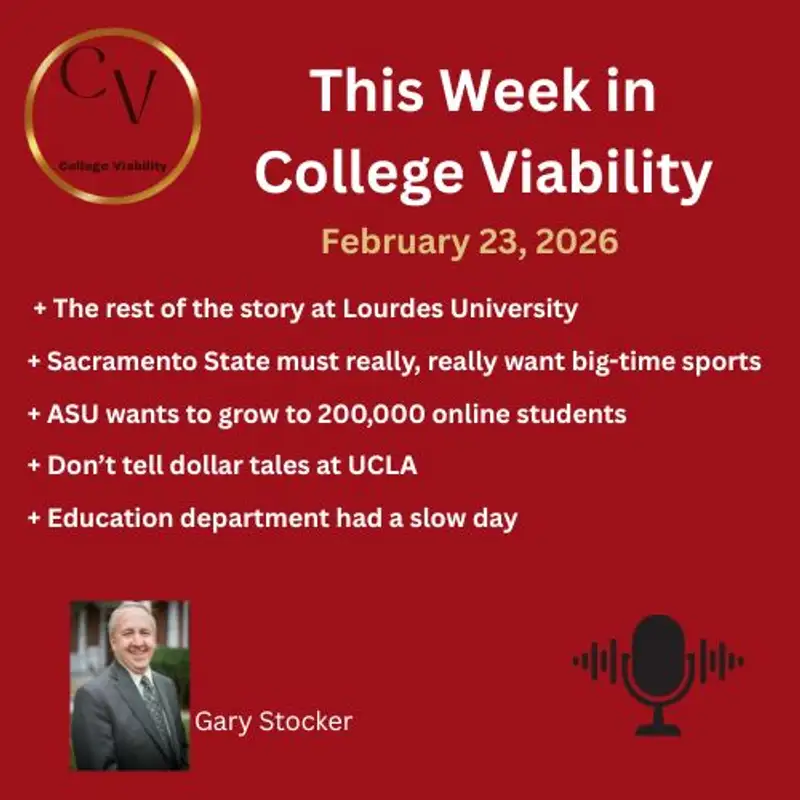
After mass resignation of the old board, Lourdes University that announced its closure a couple of weeks ago, Lourdes University appointed new trustees who then voted to close the school. I'll have that story. And Sacramento, California is now getting big time college football. Sacramento State is moving to the FBS, which is the big boy college football division and the Mid-America Conference. Yes, Sacramento, California is moving to the Mid-America Conference. Write that down in your notes.
And Arizona State plans to add tens of thousands more to their online student enrollment. If you have a mom and pop online enrollment program, be careful small colleges are offering just a handful of programs. It'll be tough to compete. The UCLA Chief Financial Officer blows the whistle on some university finances. You will be interested in the outcome of that. And the Education Department moves to eliminate regional accreditor.
Gary D Stocker (02:27.234)
the regional accreditor label in major higher ed shakeup. It must have had nothing to do on that day, but we'll talk about that as well. And of course, don't be a podcast hog. Make sure to share the podcast link with your higher education colleagues, those looking at colleges, your media friends and any others so they can get what I think is a unique perspective on a troubled higher education industry in so many ways.
layoffs and cutbacks. There was a lot last week, not quite as many this week, but still a number. Yale College has laid off some employees as it reduces staff. On Thursday, Yale College Dean, the Dean is personally, I'm sorry, Pericles Lewis said that a small portion of a seven and a half percent reduction in college administrative staff has been realized through layoffs. Olivia Wu had the story on the Yale Daily News on February 20th. Now,
Yale College is the undergraduate branch of Yale University, the big boy. It offers something like 80 different subjects across many different disciplines, and its signature residential system and expansive programs support a community of students and staff. That's just marketing stuff that I should have taken out of my show notes. University of North Texas faces a $45 million budget shortfall amid state funding cuts and drop in international students.
Priscilla Hogan had that story on February 19th at CBS, Texas. University leaders say this shortfall is due to multiple factors, but the main two are a loss of state funding and a decline in international masters student enrollment. And again, the story is the same. The details are different, but the market is collapsing in so many ways and the numbers are different. But this college is going to struggle. It is what we call directional college, North Texas.
and it is a regional college for sure. one of many, Washington State is where we go next. Washington State University to close the Yakima College of Nursing and send students to Tri-Cities and Spokane. Robert de Saunier had that story on February 19th in the applevalleynews.com site.
Gary D Stocker (04:47.65)
Nursing students at Washington State University's College of Nursing will have to finish their programs in the Tri-Cities.
Gary D Stocker (05:00.942)
in the Tri-Cities or Spokane campus on February 6th, WSU announced that its College of Nursing would transition its Yakima Bay students to the Tri-Cities and Spokane. Washington State claimed that the 28 students in Yakima will have to choose where to continue their education. That seems a little harsh. Normally colleges have that all lined up beforehand and they're quoted as saying at Washington State,
This difficult decision reflects our commitment to strengthen the region's nursing workforce while being responsible stewards of limited resources. You know, I'm going to put that as my college drivel comment for the day. And they go on to by focusing their efforts. Same kind of stuff. hear other places. Central State University, Ohio. Central State University lays off faculty as financial woes continue. Sheridan Hendricks had this story in the Columbus Dispatch on February 22nd.
the layoff at Central State University, more than a dozen faculty members at the end of the spring semester. Administrators at Ohio's only public historically black university notified 16 faculty members that their contracts would not be renewed for the next school year. Faculty members will be paid through August. So kudos for at least providing some support for those faculty. Page two.
After mass resignation, Lourdes University appointed new trustees who voted to close the school. And I've had this story for the last couple of weeks and we know that Lourdes University announced its closure a while back. But as the late great Paul Harvey said, we now have the rest of the story. And Alex Bracken had this story for The Blade last week. It was on the 17th, I believe. Here's what Mr. Bracken wrote. Lourdes University's Board of Trustees
resigned en masse in December after catching wind of the Sisters of St. Francis' intention to close the university. The Lord's is a Catholic university. It was supported by the Sisters of St. Francis and they wanted to close the university. So here's what goes on and here's the rest of the story. In the absence of a board quorum, because all the boards resigned, the Sisters then appointed seven brand new trustees.
Gary D Stocker (07:25.144)
to join three sisters and the president of the board who eventually voted to close the university and that closure will be in this coming May. So effectively the sisters of St. Francis decided they could not continue to subsidize Lourdes University. Nothing wrong with that. They made a business decision. It was going to be traumatic for those already at Lourdes. It was already traumatic because the financial health of that college was miserable.
that the old board of trustees didn't the wisdom to acknowledge that financial reality for the Sisters of St. Francis. In my book, that's a sad commentary. One of the old trustees, ones who resigned, one of the ones who resigned said, the board resigned because we all collectively believed that the university did not need to close and that all options had not been fully pursued.
or allowed to be executed, and as you'll recall from last week's they had been trying to develop a strategic plan, I think, for two years. Sarcasm alert.
What a way to be, what a way to not be leaders.
Arizona State adding plans to add tens of thousands to the new to their online student enrollment program. Helen Rommel had this story in the Arizona Republic on February 20th. As always, I'll have the link in the show notes. Arizona State's President Michael Crow said they hope to have an online total enrollment of 200,000 students in the coming years. If you are running or starting to run or
Gary D Stocker (09:08.302)
thinking about running a small online program, be wary. You are going to be challenged to compete with the marketing, with the academic and non-academic scale that Arizona State and other big players will bring. If you have just dipped your educational toe in the online waters, you had better have a pretty unique offering to have any chance of generating materially significant new
Net revenue, the big boys are coming after you. And right now it's ASU. It will be the other big boys soon, if not already out there. In the category of Christian education, Multnomah College gave up its campus in a failed takeover. The alums at Multnomah, at least some of them, want it back. Bob Smetana had the story along with David Adams on February 16th. They did talk to me about this story a few months ago.
and it was released on February 16th in Sight Magazine. And this is a buy a college, get its assets, buy a college, get its assets story. And here's part of an open letter from Multnomah, the folks concerned at Multnomah, which closed. And it's now having its assets sold, this property sold, this building sold. The open letter from Multnomah faculty, I'm assuming from Multnomah alums.
we see two moral issues that require justice. First, Jessup, the merger partner, Jessup presented itself as financially strong and able to add a branch college.
In fact, they say a day late and a dollar short, public records show that they were $74 million in debt and did not have additional capital to create that new branch college. Second, Jessup failed to sustain a Christian college as agreed. Whether they would not or could not keep the promise does not change the result. We believe this failure to keep their agreement, I'm having a tough time following this,
Gary D Stocker (11:15.522)
We believe this failure to keep their agreement disqualifies them to sell the campus assets that they already own now and take the proceeds that were earned by Multnomah over 85 years. And there are some supporting documents available as part of this at a website. And I'll try and remember to add that in the show notes as well. And there are certainly sad components to this story.
I'll just note the fact that college viability has existed since 2019. Drop me a note, connect with me on LinkedIn, reach out to the many connections I have in higher education. I could have easily looked at the long-term financial health of both Jessup and Multnomah. I could have saved lots of grief if indeed Jessup did not have the resources.
I guess nobody thought to ask or their due diligence was misleading or incomplete or uninformed, something like that. And this is kind of a corporate level reverse caveat emptor instead of buyer beware. In this case, it's seller beware. Even though was a done deal, the folks at Multnomah, they went the toys back. And if you're a college that needs merger help,
be on the sell side or the buy side or just a joint merger of multiple colleges. Drop me a note. Gary Stalker, drop me a note to gary at college viability, gary at college viability dot com. And I'll make some introductions. I don't do the consulting myself. I don't have those skills, but I can certainly make some introductions. Page three. Hallelujah. California has Sacramento, California, the capital of California is getting a new big time college football program.
And so some economics experts weighed in on Sacramento State's move. Like I said, at the top of the show, the Mid-America Conference. Documents show an 11 million dollar athletics budget. As the university prepares, write this down, 11 million dollar budget previously prepares for a 23 million dollar total entry fee. Denzen Cortez and Michelle Dapper had this at KCRA 3 TV.
Gary D Stocker (13:34.254)
In Sacramento, I'll have the show link. $6 million during the first year, $18 million paid to the Mid-America Conference, and $5 million paid to the NCAA. Sacramento State is also taking no conference distributions. I don't know for how long. This story doesn't say. And we'll cover the air travel. Goodness, they negotiated a nice deal at the MAC. And we'll cover the air travel costs for visiting MAC teams, that's Mid-America Conference teams. The Hornets, that's the Sacramento State Hornets.
will not be bowl eligible until the 2028 season. So that will be 26 or two seasons, I guess. To join the Mac, will also have to make upgrades to the current locker rooms and the visiting athletic directors box at their venue. University president, the Sacramento State University president, Luke Wood has been vocal about his belief that Sacramento State athletics
belong at a higher level. Well, I'll talk about that here in a second. He goes on to add, have 21 intercollegiate sports, 21 of them, he said in an interview, and for the vast majority of them, they are in the wrong home. All right.
If this were a video version and not an audio version only, you'd see on my forehead it says, Data Nerd. So to the folks at Sacramento State, make whatever business decision you think is best. If this were a bettable event, I could go to Las Vegas and bet on this. I would wager layoffs and cutbacks. Layoffs and cutbacks are in the future at Sacramento State to help pay for this. And for those of you keeping actual score at home of the
Recent success or lack thereof of big time sports at Sacramento State. The football program in the last three years is 13 wins, 23 losses. Men's and women's basketball also had substantial losing records in the past three years. I don't know what to tell you. I'm entitled to my opinion. Here goes. I vote Ego Trip.
Gary D Stocker (15:48.238)
I vote ego trip and resume builder for somebody somewhere. Page four, the UCLA's chief financial officer. Blows the whistle on university finances. Adam Zaki had this story at CFO dive on the 17th of February. He said they were driving projected 425 million dollar deficit. So Stephen Agostini, who was a CFO,
When he did this, he was a CFO at UCLA. After he made these comments to the Daily Bruin, which is a student newspaper, Mr. Agostini was terminated. He was fired. UCLA vice chancellor for strategic communications, Marius Sokos, said recent public references to a 425 million deficit are inaccurate.
noting the figure includes proposed or unapproved spending and does not reflect the university's projected operating shortfall. Apparently there is one, though. Asako said UCLA's financial pressures stem from broader institutional and external factors, like everybody else, and emphasized that campus leadership remains confident in its financial oversight. She added that the university is pursuing new revenue opportunities.
Again, new revenue opportunities in a shrinking market, even though it is UCLA, while focusing on operational efficiency and disciplined cost management. Goodness gracious, I need some Advil. My head is spinning as I read them trying to spin their way out of this. So something else Mr. Zaki said in the story, and I missed this one. He notes that across higher education, reporting challenges have increasingly shaped leadership transitions and institutional strategy. All right, big statement.
In July 2025, the soon to be closed Siena Heights University detailed allegations from a former finance chief to accounting concerns. And in March 2025, Oklahoma State University's audit revealed funds had been improperly categorized and transferred, prompting executive changes and renewed oversight. So great.
Gary D Stocker (18:09.098)
in the midst of maybe the most significant historical decline in this market ever. Higher education must now also watch the folks who watch the money, their chief financial officers. And finally, the education department moves to eliminate regional accreditor label in major higher ed shakeup. Chris John had this story on February 16th in the University Herald.
Gary D Stocker (18:38.36)
The department's announcement last Thursday highlighted concrete ways the regional label harms students and drives up costs. Now I'm thinking that they didn't have much to do this day and so they thought, hey, name change. So a couple items in the story. They're suggesting that the regional reference has transfer credit discrimination. Some of this is true. Many colleges maintain transfer credit policies that deny students credits.
earned at nationally accredited institutions as opposed to regionally ones. right, to regional ones. Confusion for families, the terminology misleads students and families trying to evaluate college options, suggesting that geographic scope indicates quality when federal standards apply equally to all recognized accreditors and...
The final one, the distinction maintains traditional higher education hierarchies that may not reflect actual educational quality or student outcomes, potentially protecting established institutions from competition. All right, I can see the logic in that. Let me just go with the one on may not reflect actual educational quality or student outcomes. And I've talked about that one many times over the past few years.
And I'll share what I've said before. Current accreditors, regional or national, whatever you want to call them, have a conflict of interest. They have a conflict of interest. Their main source of revenue is the fees, the colleges they review, pay them.
Gary D Stocker (20:22.262)
As you listen to this podcast, do you not think for one minute that some of these, some of the discussions inside these current accreditors and potential new ones is how can we drive increased revenue? How can we drive increased revenue by giving colleges what they want? All right, nothing with that, nothing wrong with that on the surface, but it's quite reasonable.
to assume colleges want less accountability.
so they don't put their access to Title IV funds and their financial viability at risk. And the only solution in my mind is something similar, and I've said this before, is something similar to what Consumer Reports does. Consumer Reports is a for-profit company that generates revenue from consumers, from its customers, who buy its products, its catalogs, its magazines, its website access.
something similar in higher education should replace accreditors.
Maybe that's something that I work on. it's something others are already working on. The bonus benefit to this, I've not talked about this before, the bonus benefit would be that some of these, what I'm going to call false flag college review sites could also be replaced. If you aren't already aware, sites like niche.com and others generate revenue, nothing wrong with that, but they generate revenue similarly to what accreditors do. They charge colleges.
Gary D Stocker (21:58.382)
to be on their site.
If those colleges are paying a fee to be on their side, you can bet there ain't going to be any bad news about those colleges on those sites. So let's do our weekly rapids. The story about Accreditors is one of the reasons I think our new college viability transparency tool will be enormously successful. Our revenue will come from users who purchase our products.
to compare the objective data on private and public colleges. There will be no party scene or campus food or dorms or student life comparisons in our tools. Those are so subjective.
And even if they're survey based, which they are, they're still subjective. And as I wrap up this podcast, let me introduce another silly phrase that I haven't talked about before. Another silly phrase used in the college selection process. And if you'll bear with me, let's call it a Gary's tantrum time.
I have no idea what college fit is. No idea what a college fit is. It is a term used by too many to guide students toward a college decision. If you're in the industry, if you're looking at a college for yourself or your loved ones,
Gary D Stocker (23:26.51)
It's subjective term that's supposed to be instructive in helping students choose a college. It is a magical, fictional, nebulous term admissions officers and others use to describe a vibe that costs tens of thousands of dollars a year. It's kind of the old Goldilocks principle. Finding a school that isn't too big, isn't too small.
Isn't too hot, isn't too cold, it's just right.
FIT should include objective measures like we have on the college viability transparency tool. should include things like we do, enrollment trends, admissions yield, financial health indicators, and much, much, much more that are not included in any cases by the colleges because they don't like the numbers that come out and by these websites as well. FIT, the use of FIT, College FIT is another way that colleges obfuscate
Poor finances and poor results. Not good.
Hey, until next Monday, let's do this again on Monday, it was gonna be March, right? It's gonna be March, early March. I took my calendar down today, early March. And as always, I'm grateful for those making time to listen to the podcast, make sure to share the podcast link with others. And if you have feedback, good, bad, challenging criticisms, drop me a note to gary at college viability, gary at college viability.com, and we'll be back next week with another podcast show.