This Week In College Viability (TWICV) for Feb 16, 2026
Gary D Stocker (00:01.214)
It is Monday, February 16th, 2026. Welcome back everybody to another podcast episode of This Week in College Viability News and Commentary. Hi, Gary Stalker back in front of the blue Yeti microphone. I'm working on that pronunciation. Big, big week at College Viability with news about our business. We have released both the 2026 College Majors Completions app for academic leaders and one for students and families. I'll have more about that.
in the coming weeks as well, it's now available. Both are now available at collegeviability.com with some special promotional pricing. So take a look at those. If you want to know which colleges are doing well with certain majors, I track that. And on the other hand, if you want to make sure the college you're considering or the college are already at are offering a significant or acceptable number of majors, this is the app to use that. then just today, mark your calendars, February 16th, 2026.
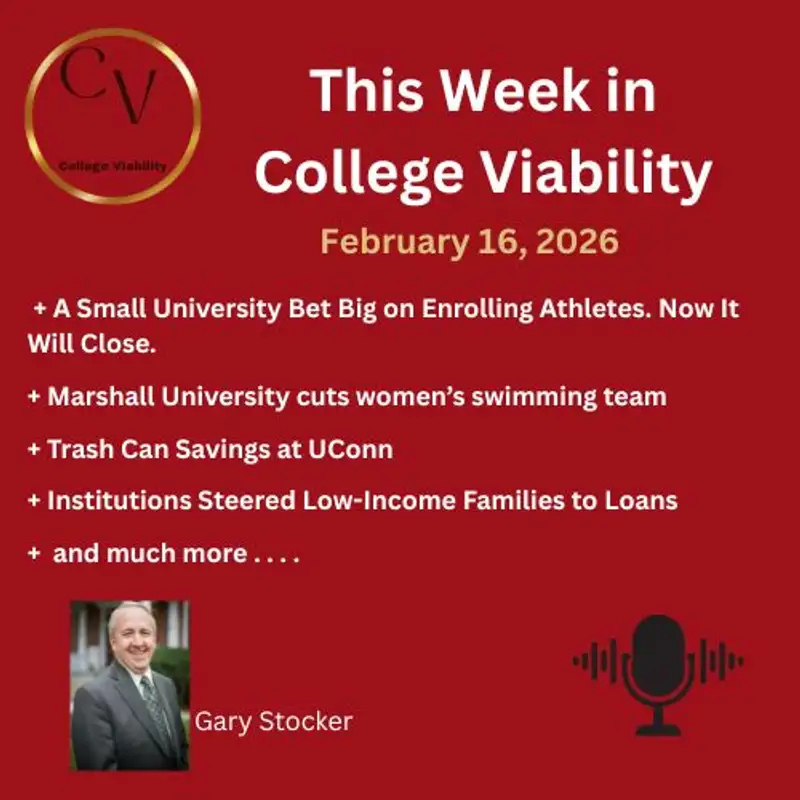
The college viability transparency tool is out the door and ready to go. It is dedicated to students and families. And again, I'll have more on that in the coming weeks and months as well. News and commentary this week. A small university, large university in Ohio, a small university bet big on enrolling attendees, excuse me, on enrolling athletes. And it announced its closure last week.
Marshall University cuts women's swimming team. And this was after just a week or so ago, they posted some glowing notice how the college was doing well on internal release from the board of trustees. I have more details on that. In the I can't believe it's a story category and probably not a Pulitzer journalism award winning story. The University of Connecticut.
looking to save one point one point five seven million dollars. Removes trash cans. Yes, that's right. Removes trash cans from many of its offices. Ladies and gentlemen, not making this one up. I have details in a minute. Next on the list report from New America that 41 colleges, 41 institutions steered low income families to loans. I have a lot more on that.
Gary D Stocker (02:23.016)
And some more doozy stories. just didn't put them in the headline teaser. And as always, I tease about don't be a podcast hog. Make sure you share the link to this podcast to your higher education with your higher education friends, faculty, colleagues, families, neighbors next door. Let them listen to a perspective that's different than almost any other higher education podcast that is out there. Let's start off with lots and lots of layoff cutbacks and closure stories.
The lead today of small university bet big on enrolling athletes. Now it will close. Eric Kelderman had the story on February 11th. Kelderman writes in a sign that athletics can't always save struggling colleges. Lord's University, a small Catholic institution outside Toledo, Ohio, announced Wednesday that it will close at the end of this academic year. Lord's had sought, Kelderman writes,
Lords had sought to bolster its numbers by dramatically expanding its athletic programs. Those efforts did bring in new students to campus. But even with that, overall enrollment continued to decline. And kind of a pivot on this story, Steve Dittmore, D-I-T-T-M-O-R-E, is a scholar of college business athletics and the Dean of the Silverfield College of Education and Human Services at the University of North Florida. That's going to fill up a business card.
Dr. Dittmore says that, and his research shows that if colleges have more than 42 % of their student population as athletes, they are at demonstrable financial risk. 42 % is Steve Dittmore's number. Lords University was at 72 % of its enrollment with student athletes. So here's my observation. Colleges like Lords,
use adding sports program as kind of a management by PR. You've heard me talk about that before. A management by PR tactic. They say, hey, look, we're adding new students. And I'll bet, I'll bet a buck fifty that the accounting they use for these programs doesn't include net cash from operations for each individual sports program. I bet they all throw it into a lump. And I also wonder if the sports programs cost structure.
Gary D Stocker (04:47.862)
I'm sure they allocate for costs for coach's salaries and uniforms and officials and travel and room and board and those kind of things. But I wonder if they even try and allocate for the administrative overhead. All other departments have allocated costs for the president, CFO and marketing and all those non revenue generating positions. Sports is not a cure all. And yet there continue to be colleges add sports and I'm not going to name the sports, but they're ones that.
We'll call them non-traditional. We'll call them non-traditional. Curie College, C-U-R-R-Y College, acquires La Bore, and La Bore College will shut its doors this summer. Maya Sheva had the story in the Boston Business Journal on February 12th. It's another small college closure, and that's the third one. This week is Pasadena's Providence Christian College to close after two decades. This small Pasadena school.
cited low enrollment rising costs and the loss of federal funds. This was in pasadena now.com on February 11th. The story in part reads the college's board of trustees voted February 7th to shut the institution down. After concluding there was no path to long-term survival, President Stephen B. Cordenhaven said, Providence only enrolled 168 students last fall. That's really small. Publicly available financial records like the ones I use
So the college carried an endowment, I can't believe how low this is, carried an endowment of just $25,000 in change. That's not even college couch money and operated at nearly a $1 million loss in fiscal 24, that source, inside higher education. And in the category of mea culpa, I didn't have this one on my radar, probably because it was so small. So I was surprised when I saw this one pop open. I think it was the same day of Lord's announcement as well. Marshall University.
cuts its women's swimming team. And this broken. The story was broken by Pat Ford at Sports Illustrated on Friday, February 13th. And pro team source, that's according to Pat Ford, Marshall administrators have informed the women's swim team that the program will be cut after the season. Apparently there are 26 underclass women on the team. Incomprehensively, Ford writes they just hired a diving coach in late January. Now there's another story on this.
Gary D Stocker (07:13.774)
This is from the West Virginia Gazette. Tyler Connette had the story also on February 13th. And another one from SwimSlam. That's right, SWIM. SWAM.com talks about cutting the program. Team members were told that the decision was made for financial reasons, which was referenced in an email sent to those team members. The college, and this is from an athletic director, Gerald Harrison, the decision was made
after evaluating what is required to provide the highest quality student-athlete experience over the long term," Harrison wrote in an email. So let's be clear here. If you think I'm about to issue an indictment, that's not going to be the case. Outside of the confusing February 5th glowing press release from the Board of Trustees, really in my mind, Marshall University appears to be engaging in a conscientious and data-driven decision. It happens. The Swimmers, of course.
or any other athlete in any other sport at any other college will be crushed by this news. It's happened before and it's going to happen again. And Marshall may be a little communication clumsy, but their actions are reasonable. The FAQ that I saw for their student athletes was thoughtful and reasonably thorough. Here, you know how I like to step back and look at the bigger questions. The bigger question, the one we should ponder as we look ahead.
is how many other colleges, how many other colleges are pondering these types of athletic program eliminations. I bet that same buck 50 it is happening at scores, scores of public and private colleges across the country. Maybe even those at the power of 4.5 level, the big schools, the big boys and girls, they've got to be having those discussions. The numbers just don't work for what we're seeing all across.
College athletes, college athletics. University of Denver, a high quality prestigious college. University of Denver braces for up to a $30 million budget shortfall next year. And that would be fiscal year 26, 27, I believe. This story was in the Denver Post. Elizabeth Hernandez had the story. On Valentine's Day, February 14th. And again, same story we've had before. Details are in the show notes and the links that I'll provide there. It's just another college. 30 million is a big deficit.
Gary D Stocker (09:41.784)
But again, University of Denver is not going anywhere. They have a strong endowment, really strong investments. But trying to maintain a balanced budget and keep revenues in excess of expenses, I think we'll probably see more stories where there are cutbacks in programs, elimination programs, and almost certainly cutbacks and layoffs for employees, maybe even faculty at the University of Denver. How about student protests? Students and faculty express concern about layoffs at the College of Wooster.
This was from Ideastream Public Media. Connor Morris had the story on February 12th. And this is a typical dog bites man story. You can read the details in the show link. And here's what I found with my my quick research that I can do with all the data sources that I have at my fingertips. Wooster's past two years, past two years, Fiscals 23 and 24, show operating losses greater than 10 percent in both of those years.
Now I can't and won't speak to the leadership's ability to communicate, same thing we had at Marshall. But again, this looks like a reasonable reaction to their imbalance of revenues and expenses. Are people going to be upset? Absolutely. Are they going to feel betrayed? Absolutely. Is it justified? that's a tougher call to make. And again, just like the University of Denver, Worcester's not going anywhere. They are asset strong, asset strong in endowments.
in investments and their overall unrestricted net assets. But like so many other public and private colleges, their expenses are exceeding their revenues and they're just trying to get a handle on it. The market is declining. Yeah, I could record that and stick it in every show that I do. The higher education market is declining and this college is trying to do what many colleges can't or don't, and that's get to a balanced budget. Conor Morris also reported, this was interesting.
The college has seen a lack of stable leadership in recent years with five, count them, five presidents across the last 13 and a half years. And a representative from the college said that's led to too much short-term focused decision making. So there is that.
Gary D Stocker (12:05.57)
These stories this week go on and on. The University of New Haven loses thousands of international students. Details in the show notes. This is from Connecticut Public Radio. Eddie Martinez had that on February 3rd. Page two, finally, out of layoffs, cutbacks, and closures. Yeah, and I teased this in the opening.
Sit down for this one. The University of Connecticut looking to save 1.57 million removes trash cans, trash cans from many of its offices. I saw this on MSN. Michael Gagne had the story on February 15th. There's a lot to unpack here.
I know the podcast is audio only, but if you are seeing the video right now, I'm struggling. I'm struggling to keep a straight face on this story. According to a Yukon official, the trash disposal related changes were enacted so resources could be refocused. Refocused on needed areas in response to the budget reductions. All right. Maybe I yield the point on that one.
Eric Krueger, the university's vice president of facility services and university planning, said in an email to the faculty last August, they were expected to net about $131,000 in monthly savings through the change of removing trash cans from offices throughout the UConn campus. Emails advising faculty that trash cans would be removed went out last fall and...
Kruger also advised employees to begin emptying their trash office bins into hallway trash receptacles. That's gotta be a good look. It went on to say, Mr. Kruger went on to say, UConn is not unique in scaling back its trash pickup scores of higher education institutions, state and local government agencies and other entities nationwide have adopted centralized waste collection over the last 10.
Gary D Stocker (14:15.992)
plus years, he said, for those of you looking to get a good deal on used trash cans and help the University of Connecticut through its financial challenges, I'm guessing eBay now has thousands of Yukon-printed trash cans available at a good price. Onward, onward, we must go. More negative stories about the industry too. Marshall University, which we've already talked about on the show.
and Agnes Scott College had negative Fitch Ratings reports last week. I have links to both of those thorough reports. It's finance speak. Both of those reports will be in the show notes. Page three and kind of scary. There's a report from New America that 41 colleges, 41 institutions steered low income families to college loans.
Gary D Stocker (15:11.682)
Joanna Alonzo had the story on February 13th and inside higher education. Ms. Alonzo reports that students at dozens of universities who are eligible for Pell grants also take out Parent PLUS loans. We know that in order to afford tuition and other costs. Raising questions, she writes, about how some colleges dole out their institutional aid dollars. Now there's a lot more to the story.
Many of the institutions that Joanna Alonzo cited pushed back on the charges that they were doing this. Again, I'll have the link in the show notes. You can draw your own conclusions. I'm not going to get into a soap opera digest on this. There was a similar story, as I recall, out of Texas, I think it was last year, when Baylor University was criticized for predatory inclusion. That's a fancy name for the practice of aggressively recruiting
low-income students, while steering their low-income families toward higher interest federal loans and the debt that accompanies those. it's not a good look. True or not, that the story made it into Inside Higher Education. This is not a good look for our higher education industry. the appearance, even the appearance of impropriety.
is another market obstacle. And that's what I look at it as. It's another market obstacle that this industry can ill afford. Robert Kelton had a social media post that did a good job of summarizing a report from the National Association of College and University Business Officers. I didn't even have that in my notes in a Kubo. He reports higher endowments saw solid financial returns in fiscal year 25, but spending rates ticked up again, almost 5%.
5.4 % of private colleges and 5.5 % at colleges with small endowments.
Gary D Stocker (17:16.29)
Dr. Kelchin notes, overall, this is fine, but roughly 10%, he says, roughly 10 % of privates are spending more each year than they can expect to see in earnings. That means they are eating their seed corn. His word's not mine. They're eating their seed corn and diminishing their future capacity. That's probably a pretty good way to put it. Dr. Kelchin, I'm sorry that you beat me to that one. I would like to use that one for my own. And as always, these...
big picture reports while accurate no doubt. Don't detail which colleges are in trouble.
providing essentially no guidance or support for students, for their families, and others. And by the way, we have fixed that with the new college viability financial transparency tool. There's a long name. We now provide transparency and more details on that soon, of course. And Matt Hendricks College Financial Compass shows the average endowment return
for more than 1,000 private colleges since 2016. His app shows which colleges have fallen below that median value for the last 10 years and which have fallen above, some have, many have, above that median value for those years. Typically, the colleges that Dr. Kelchran references are drawing down that endowment, using up their seed corn to use his words, drawing down their endowment to keep the lights on and probably
probably to meet payroll needs as well, and that's not good. So here's the stat. The median, this is from Matt Hendricks app, the median end of year private college endowment growth in 2024 was up almost 60, 60 % since 2016, last nine years. When I went in to do this quick note for the show, I happened to have a college up on the app that I was looking at for something else that showed a 15%, one five percent increase
Gary D Stocker (19:18.72)
in the same time period, 2016-2024. Now, I don't know, but I hope this college was not proud of themselves for having a 15 % growth rate since the median was 60%. This college at 15 % was in the bottom below, the bottom 25th median, one of 25 % of lowest earning, lowest endowment earning colleges.
in the private college world. four, we've got a frequent flyer. We're going to ride our university in New Jersey. State approval affirms riders progress under March to Sustainability Plan. OK, the state of New Jersey and agency there approves riders progress. Let's go to the details. Let's go to the data.
This is an internal story at Rider.edu, so it's going to have some bias. They posted this on February 9th. The New Jersey State Approving Agency... Interesting name. The New Jersey State Approving Agency finds no discrepancies as the University, Rider University, prepares for a March accreditation review. I believe that's with the middle states. Yeah, the middle states. Here's what the story reads. Rider University has received an affirmation of approval.
from the New Jersey State Approving Agency following a risk-based survey conducted in January. Now listen to this next part. The agency cited Rider's cooperation, they cited Rider's cooperation with the accrediting authorities and the university's comprehensive financial recovery plan as the key context for its decision.
Goodness gracious, these people must think we don't follow and not enough of us do. So, all right, Rider U is a frequent flyer on the podcast. They've been on the College Financial Health Show with Matt Hendricks and Gary Stocker on a regular basis. They're just not doing well. And again, this time we see accreditors, this time at the state level. Their approval is based on what? On a plan. Some well-crossed T's and well-dotted I's, I presume. The approval is based on a plan, not
Gary D Stocker (21:43.662)
on results to the data we shall go again. Rider University, New Jersey. This is a college with double digit negative losses. Negative change in assets, we call that losses from 2024 into 2025. The unrestricted net assets were negative in both 2023 and 2024. That ain't good. Total net assets decreased. That's very difficult to do unless you're selling stuff off.
Total net assets decreased about $80 million, $80 million, and student revenues decreased $15 million. But, sarcasm alert, but they are good to go because clearly they are nice and say good things about the state agency.
If I am in New Jersey, I want to know how this state agency is protecting its students, its faculty and staff and communities with what can only be described as a short-sighted affirmation. Rider University is not financially strong. No plan on earth will convince me otherwise. You show me changes in actual results from audited financial statements for the next
two to five years, then we can talk. But this approach where accrediting agencies, and not just this New Jersey state agency, but the main accrediting agencies throughout the country, say a plan is good enough, it's not good enough. The Middle States Commission on Higher Education report is due out this spring. Trust me, I won't be keeping an eye open for that story in my many, many, many Google alerts.
that I use each week. So let's do the rap. And I let off this podcast with seven stories about college closures and layoffs and cutbacks. And I cut out a couple because they were going to make me run too long on the podcast. And there were even more stories popping up as I prepared the podcast over this past weekend. As I noted earlier, the college viability financial transparency tool comes out today. It's out. I just got word.
Gary D Stocker (24:00.628)
It is my effort here at College Viability to improve the I have available, to make available, for giving students and families mostly, but faculty, counselors, and others with more transparency on the financial health and even viability of private colleges. The public college version comes out later this year. It includes four sections. Again, the focus is for students and families. We want them to be informed. We want them to ask good questions when they're searching for their colleges, for private colleges in particular right now.
first one is understanding your options. And as the best I can tell, this is the only app that helps students decide should I go to college or not. And we have put together a resource where you can pick a job, let's call it a barista, and a marketing manager. I think that's our example. And it actually steps you through what the cost of college will be and the income levels you can earn for those starting from, I think, the day after high school graduation, up out 30 years. And you can make an informed decision
And the whole mindset behind this is informed consent on making college decisions. You can look at the data before deciding is college right for me with the expenses and the time associated with going. The second part is creating your college list. We're going to help students, families and others create a focused, realistic college list based on academic outcomes, graduation rates, investment in the student experience, cost and financial risk. And that means the risk at the college.
rather than just by going with the college's perceived reputation, marketing documents, and the other apps and the other sites that out there that really make money off of trying to sell colleges to you. The third one is campus visit. We're going to provide customized questions you can ask during your campus visit, either to your tour guide, which won't be particularly productive, or to admissions representative for each college. We'll give you the questions. We'll give you an example of a bad response.
and we'll give you an example of a good response. then finally, making your decision. We're to bring together for our clients, for our customers, the costs and the risks at a specific college to make a informed, fully informed consent decision about enrollment, understanding the likely best case and worst case outcomes before ever committing to any college. So let's call this financial transparency tool similar.
Gary D Stocker (26:27.896)
to what many of you might know in the Kelly Blue Book. Kelly looks at tires. Kelly kicks the tires on cars and says, these are good, these are not so good. Well, we don't get tires on cars. We kick and compare the data most colleges either don't want to share or can't share, along with some of the more common comparisons. You can also consider our financial transparency tools, a reverse FAFSA. I've talked about this before. You share your financial health with colleges on the FAFSA.
You tell them your finances. Our tools share the financial health, all the tools across all of our products. Our tools share the financial health of colleges you are considering seems fair to me.
So finally, two closure announcements, early three this past week, six layoff and cutback stories, ever more. And there will continue to be many of both.
Our tool is going to be released, is released, as a complimentary resource, that means no fees initially, as we try and get it in front of as many people as possible, students, families, counselors, faculty, staff, community leaders.
At College Viability, transparency is our focus, always has been. We continue to find better ways to transparency, to present comparisons to colleges, and we do it well. Of course, that's my opinion.
Gary D Stocker (27:57.87)
College leaders, have resources for you at collegeviability.com. And for students and families, it's my college, my collegeviability.com. Those where the resources are available, go check them out. For students and families, the resource and counselors, the new resource, the transparency tool is offered as a courtesy right now. Take a look at it, play with it, see what you think, and send us feedback. We have a resource available for you to do that as well. So that is an official wrap.
Of course, we'll be back next Monday on February 23rd, the last Monday in February with another episode of This Week in College Viability. So grateful for those of you, and it's hundreds and hundreds each and every week that download and listen to the podcast. Feedback, as always, is welcome. Good, bad, critical guidance, suggestions. Send your feedback to Gary Stalker, to gary at collegeviability.com, and I'll be back behind the blue yeti microphone again.
Next Monday. Until then, take care.