This Week in College Viability (TWICV) for Sep 7, 2026
Gary Stocker (00:01.12)
Yes, indeed it is Labor Day 2026, but we're gonna do a podcast anyway. Hi everybody, Gary Stalker in front of the Blue Leti microphone on this Labor Day 2026. It's September 17th, and time again for this week in college viability news and commentary. And you know what we talk about? We talk about college financial health and viability, and too many times is about spin. And that's this time of year. We'll talk about that a little bit tonight, today as well.
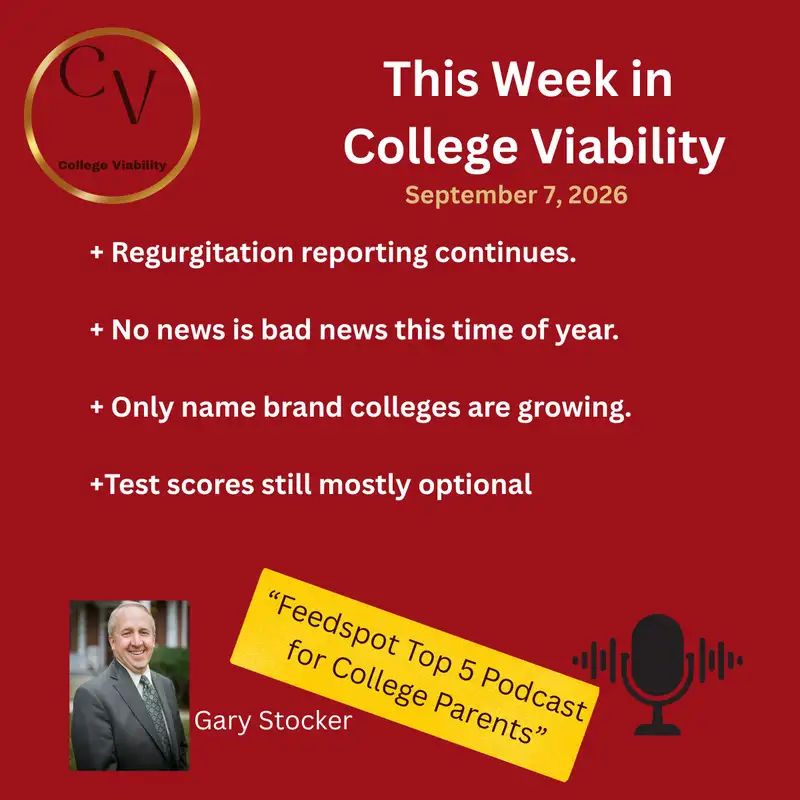
And this week on this week, what are we talking about? Regurgitation reporting continues, and there are some really good reporters, some really good higher education reporters out there, and there are some that take a college's press release and publish it as news, and I'm gonna talk and talk about it and I'm gonna point that out. And something to think about, and I think I had this on the show last week. This is the time of year when colleges post enrollment numbers, good enrollment numbers. They rarely post negative enrollment numbers. And
We talk about that. But here's what you want to look for. Look for those colleges that are posting no news about their admissions. That's bad news. If you're concerned about your college and you haven't seen a press release touting phenomenal new enrollment, give them a buzz, drop them a note, and ask them why they're not sharing enrollment news, because I'll tell you why. It's not good news. Test scores still predominantly optional. I don't know what's going on with with scores and grades.
It's like we're trying to protect an industry, and I haven't figured it out yet, but but the test scores are still predominantly op optional, especially in the less selective colleges. Name brand colleges are growing. Duh. I've talked about that over the last three or four years. interesting numbers though attached to the story. And do you need a credit card? Do you need a credit card? Is direct college admission?
The new credit card solution, and we'll have some fun with that. And of course, last week, it was last week that we released on August 31st. My college decision lens. We're changing the power structure. We're trying. Colleges are the ones showing all the information. We're giving information about colleges, and we call it the reverse FAFSA. Of course, families give financial information to colleges through the FAFSA. It's only fair. It's only fair that families get information about colleges, and we're doing that.
Gary Stocker (02:25.717)
Through the My College Decision Lens. And of course, we had My College Inspection, my College Viability Inspection Report up for quite a while now. For though, and both of those are free. The inspection report will be free for the foreseeable future. My college decision lens will have a price attached to it probably later this year, but they're both free for now. And college layoffs this week. Sit down, make yourself comfortable.
Colleges are waiting for their fall twenty twenty six Title IV checks this week and probably the next few weeks. So no layoffs yet. No layoffs this week in particular. Stay tuned as always. Page two
Gary Stocker (03:07.349)
Illinois State experiences a two percent decline in enrollment for the falls, no just a decline in enrollment. And Southern Illinois, two second Illinois College, sees historic increase.
Well what was interesting about this was this is from McCarty Jist, I believe, who's the editor in chief of the Daily Egyptian, which is a student newspaper, and the enrollment group by by to twelve thousand some odd students. I think it was an increase of almost three hundred students. Here's what was interesting. Sarah Jitter Jitter, who's a director of undergraduate admissions, says we count every student. We count every student.
Whether they're degree seeking or non degree seeking.
We have students that are even not a part of Saluki's start, that's bad writing, that comes here, that want to take courses with no intention of getting a degree, and they count them all. I'm paraphrasing there. And so interestingly, I'm gonna be talking about regurgitation reporting later. This is some decent reporting from the student at the Daily Egyptian. The Daily Egyptian requested a breakdown of enrollment numbers by student types.
including on campus and online graduate students and they are awaiting a response.
Gary Stocker (04:32.109)
Pretty honest, I will give SIU credit. This is SIU Carbondale. Yes, but SIU Carbondale credit for being honest. I'm not sure they wanted to be. they're counting people to walk by the front doors of students, it sounds like. And it gives them an enrollment bump. Well, it's all right, spin and spin, always gonna be spin. And and again, I'll go back to this no news is bad news. And I shared before I've got Google Alerts, and one of them is college enrollment.
Changes, updates, announcements. And I at this time of year, my email is jammed with colleges talking about how wonderful their enrollment is. Fine, go for it, go get them. I've talked about the spin before. I'm not gonna do that today. And I've talked about this the last couple of summers as well, this time of year. If your college hasn't released any kind of news about an enrollment increase, be concerned.
No news is bad news. If you haven't seen an announcement, drop them out, give them a call, and ask them why. Regurgitation reporting. I guess this should all be sarcasm alert. you know, I always like to give a heads up sarcasm alert when I'm posting snarky content. And then and I've talked about regurgitation reporting, not everywhere, not everywhere. maybe these reporters they typically are smaller outlets.
small areas. Maybe these reporters should consider using something like not real news stories, but regurgitated press release. Regurgitated press release. Just like I use sarcasm sarcasm alerts, just to give folks a heads up that there's no critical thinking behind this news story. We're just taking the college's press release and making it news. And today we're going to Lake Erie College, Ohio, I believe.
So data, Perspective Data Sciences Financial Compass shows 11 of 14 values flagged, including a 36% decline in total net assets and a negative almost 9 million in unrestricted net assets. The endowment is not even college couch money at 3.5 million in 2025. I will put a the fully functional college viability inspection report for Erie College, Lake Erie College, in the show notes.
Gary Stocker (06:55.105)
Because the inspection report shows eight of nine measures flagged, including for the past five reported years with operating losses. All right, I did the background first. Here's the story lead. This is the staff report from the News Herald.
Gary Stocker (07:14.069)
The Tri-County and Cuyahoga Connect programs only cost $7,500 tuition for each of the four years. This is from Lake Erie College. So what happens here? $7,500, which is low for tuition fees, probably just tuition. So we have a college short on resources giving away the store just to get students in the door.
And I gave you the financial numbers before. They're not good.
Wa you have to ask this college how are they guaranteeing a quality college education? How are they guaranteeing enough sections to get students through in four years? And by the way, the four year graduation rate averages only a mid forty percent number for the past eight reported years, and the trend line for four year graduation rates is decreasing.
So I've offered this before and and yes, I have some fun with these reporters and they're and they're less than thorough, less than aggressive reporting. But reporters, before you regurgitate these press releases, drop me a note. Gary at College Viability. One long word, Gary at college viability dot com. Tell me the college of reporting on, I'll do the work for you. I'll send you the summaries. We can jump on the Zoom and I'll step you through what's going on.
These colleges are sharing information from just their perspective, and students are probably going there because of that. And your readers, your listeners, in some cases, your viewers in some cases need to have both sides of the story, and you're not giving it to I can help. Drop me a note, I'd be glad to help. Page three.
Gary Stocker (09:08.737)
There's I think I've had this on the show quite a few times. There's a lot of talk about which academic programs to cut. And this was a university business story. and the title read What Demographic Cliff question mark colleges post enrollment highs as affordability pays off. And so I did a post on this. I took this took the link, it was from Univers University Business, and I said, We're burying two leads here.
And if you're following my social media posts, I've I'm I'm anchoring on burying leads as my tag because it's happening a lot. And the first buried lead is that hundreds of private colleges, public and private colleges, are not making enrollment increase announcements. I've already talked about that in today's show. It's a no-news, bad news scenario. I've already talked about that in today's show. These colleges are not announcing enrollment declines, and so there is a demographic cliff.
Or demographic demographic slope is a better term, I think. The second buried lead is, and there are I think seven or eight colleges referenced here that had enrolment increases. The second buried lead is that none of these announcements reference revenue, reference tuition revenue, reference tuition revenue collected from these reported record-breaking enulments. And the real question, nobody asks this except me and others that follow finance.
The real question is how much did these colleges discount their tuition? How much of the store did they give away to get to these enrollment numbers? And you know, just a quick sidebar on this: new affordability measures. In quotes, new affordability measures is another way of saying free college or lower tuition prices. Nothing wrong with either of those. But neither of them generates
Sufficient or increased net tuition revenue that's needed by hundreds and hundreds of colleges. They're playing the game to stay as long, stay the same business as long as possible. And maybe their neighbors, maybe their competitors, will fall out of business before them. What a business model that is. So let's go to the Washington Monthly. And they announced last week, I think it was, that they had their annual college rankings. Fine.
Gary Stocker (11:34.732)
You and I should put our own college rankings together too. I'm not gonna do that, you can. And so Washington Monthly, and this was a story by Gillen Tenor Martin on August 30th in the Washington Monthly, in an effort to find something different to rank than the US News and World Report or Princeton Review or even niche.com, who of course we all know gets paid by colleges to do their rate to do their ratings and listings, and others will give small colleges
Something to post on their refrigerator doors. And that's an al that's that's a a goofy analogy to what we do with our kids. Put it on the refrigerator door when you do something well.
So they came up with a category of best colleges for rural America. And now, right at the top, there are many, many, many, many exceptional small colleges in rural America. No question. And we show those in the financial stories we do. We have those in the College of Liability Inspection Reports, my College Decision Lands, and many, many other tools that we use.
There are also many, many, many small rural colleges that are watching their last dollar circle their financial drain. And I don't see the Washington Post, excuse me, the Washington Monthly, I don't see the Washington Monthly listing those. And that's why I'm here. That's why I created the free college viability inspection report and the f the currently free my college decision lens to let families and students.
And other stakeholders know what a college's financial health is, what their outcomes are, what their value statements are, what you get for your investment. We do that stuff where nobody else does all of that, even close.
Gary Stocker (13:26.773)
And then I I I've lost track of how many times I've talked about my perception over the last few summers that what we were seeing anecdotally was a move from smaller colleges, from rural colleges, from private colleges toward brand names. And I'm sure I've drawn the analogy, you and I buy brand names for everything. Cars, computers, watches, disks, I'm looking at staplers, whatever whatever we have.
We buy brand names. And I think that's happening in college. I've talked about that for a couple of years now. So Colin Kapar Kaproski had this story. He's from EAB. He's a managing director at EAB. looks like he does some higher ed strategy research. And he notes everyone talks about the plight of small regional colleges on the brink of closure. All right, he's adding a qualification I'd be careful with. But who's actually growing in the challenging market? All right. And he's documenting this. This is some some good reporting, some good some good work by Mr. Kroposki.
They grouped at ABABG at EAB, they grouped this, and Mr. Kopraski was part of that. Every four-year institution in iPeds attract enrollment changes against 2010 levels. All right, so 2010 through 2015, I would think. Five groups grew. Everyone else shrank. Let me talk about the five groups that grew.
The large online publics are up fifty-six percent. The Ivy Plus are up twenty two percent, in large part because they don't let their enrollment grow much. Large selective privates are up eighteen percent, large urban publics up seventeen percent, and state flagships up seventeen percent as well. Five categories online, Ivy plus, large selective privates, large urban publics, and state flagships.
The other 1,758 colleges declined roughly 5% on average from 2010 through 2025, I presume. So we have 175 schools, again, according to Mr. Kopraski, about 9% of the sector, holding not quite half the market, holding 40%, 47% of the market.
Gary Stocker (15:51.2)
And he notes, Mr. Kopraski notes, we've been describing these enrollment trends as the flight to size and selectivity. Okay, I won't argue with the with the word choicing there. We've been arguing that for years. He says scale and scarcity distinguish higher eds winners. Now I could probably take some minor issue with that. I think it's just simple brand names. We go to what we recognize. We go to what gives us comfort. We go to what makes us more secure.
We always have that fear of missing out on big opportunities. It's it's just now that that that brand name is just now becoming prominent in higher education. Mr. Kopraski does a really good job of noting that with the numbers he and his team did on research. Page four.
Gary Stocker (16:43.265)
The IVs brought back test scores, but 90% of colleges still don't require them. Joanna Alonso had this story for Inside Higher Education on August 28th. Why is this, do you ask? Why don't colleges require tests? And I'll tell you why. It's the need for revenue. I've talked about this before. It's the need for revenue.
Not the need for well-prepared students. And sure, the top 50 or so, top 100 or so brands get high academic achievers. Done. The rest of colleges would like us to think they do too, but how are we gonna know? They're not testing them in advance. Sure, they're gonna get some high achievers, but they're not.
Requiring these tests because they need the revenue more than they need the high quality stock or opinion. They need the revenue from these students more than they need the revenue and the and the high quality students come, but it's a function of luck, it's a function of statistics.
And that's fine. But we're gonna know we're gonna point it out here at College Viability. We're gonna point out those colleges who who don't require tests. And it's a grouping. We talked about brand names a minute ago. If your college requires testing, yet you're gonna be more certain that they're bringing in an on average a higher quality student.
If they're not, it's a crapshoot. It's a crapshoot.
Gary Stocker (18:26.765)
Let's go to the Wall Street Journal. And they had a story here recently about hundreds of colleges are sending letters of admission to students without even requiring the students to submit an application. And they're using this a handful of criteria from high schools, transcripts and those kind of things. And again, this is a revenue grab because students aren't applying, colleges are just soliciting them.
And and here's what we have going. Here's what we have going. I don't know if this is a sarcasm alert or not, but I'll throw it out there just in case. Colleges are engaging in credit card solicitation tactics. Think back to the days in the past and maybe even now, where credit card companies sent you unsolicited credit cards to spend. Colleges are now sending you unsolicited unsolicited offers of admission to spend your money on colleges.
If you disagree, drop me a note, drop me a note to Gary at college viability.com say Gary, you're nuts. You won't be the first and you won't be the last. That's how far it's come.
Colleges are engaging in the similar practices to what credit card companies did.
Sad. Sad commentary.
Gary Stocker (19:49.237)
And that's your wrap.
And I'll say this again: a college experience and degree have great value. A college experience and the degree completion have great value. The issue is there are way too many former college students with college debt and no degree. These millions of students were marketed to just to meet the college's revenue needs. Again, if you disagree, drop me a note.
And so they get the student, the student probably borrows in almost all cases to attend. The college doesn't have enough resources to support these marginal students, so many leave, they drop out, they quit, they move on.
Gary Stocker (20:34.507)
I'll make the case that hundreds of today's colleges have become the equivalent of a Kohl's department store. And I created a graphic, it's been three or four years ago now, of a Coles, a picture of a Coles department store, and I changed the name of the store from Kohl's to Coles University. Nothing against Coles. They have a coupon discount model that guarantees them cash daily. They can make it work because they have cash rolling in essentially daily, hourly, minutely, minute by minute.
And every one of their customers walks out the door with something of value: clothes, purse, jewelry, whatever the case may be. That's not the case with colleges. Their tuition discount coupons, just like Coles offers them, although colleges like to call them Meritade and Scholarships, so really not much more. And Teach Teach Matteo talks about this in his new book. The tuition discount coupons are a marketing tool disguised.
as something of value. But its main purpose, those discount coupons, those merit aids, those scholarships, their main purpose is to get students to commit to enroll.
And for those ready to pounce and say, hey, these students who drop out of college also walk out with something of value. Well, all right. Make your case. It's in a degree. Shrews in a degree that helps helps them get higher paying jobs. And again, I t t teash Matthias book out in the last couple of weeks. It's called College Is Broken. Yours children is referenced in that book a couple of times. And I did write a section at the end of the book on college spin. I guess I'm becoming
Somewhat note notable for that. And it's a good perspective. For students and parents, college leaders, faculty, admissions folks, it's a good read. And finally, the the Title IV checks are starting to arrive. That's where colleges most colleges get most of their money. And colleges in the most dire of financial situations will start to realize soon that they don't have enough cash.
Gary Stocker (22:43.169)
to continue their current operating model. They just won't. Many will continue to cut. Some will realize they just can't continue and will make the business decision to turn out the lights. To turn out the lights for good.
As always, I am so grateful for those who make time, especially on a Monday, on a holiday, to listen to this week. I'm Gary Stocker at College Viability. We'll be back next week with another show.