This Week In College Viability (TWICV) Ryan Hofer and Bex Groebner on Alternative Medicine Schools
Gary Stocker (00:00.936)
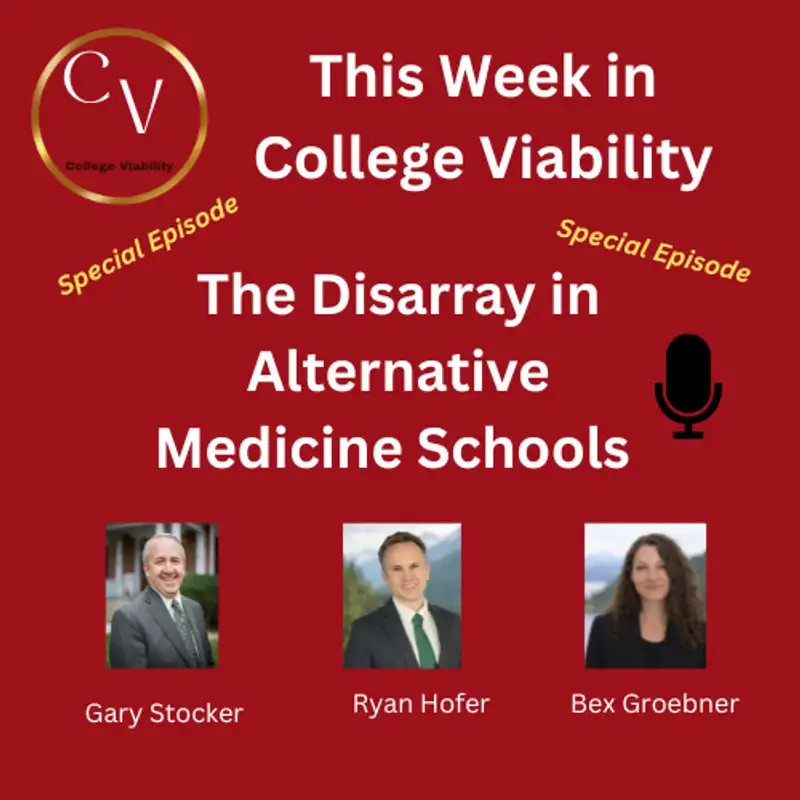
Welcome back to a special episode of This Week in College Viability. And you're used to me, your host, Gary Stalker, being a talking head. And I do that every Monday on this show. And on occasion, a couple times a month, we do a very special episode and we bring in others to talk about higher education. And that's what we're doing today. Ryan Hofer and Beck Scrobner.
Bex Grobner have joined me for this podcast episode. We're going to talk about something that doesn't come up very often, but I think is a leading indicator of what we may be seeing throughout higher education in the coming months and years, and that's naturopathic medicine, naturopathic doctors, acupuncture, and we'll probably touch on a couple other supplementary alternative medicine disciplines as we go through this. Ryan, thanks for making time to join me.
Ryan Hofer (00:54.367)
Yeah, thanks Gary. Great to be here.
Gary Stocker (00:56.648)
Back same thing, you and I did this a couple of years ago, didn't we?
Bex Groebner (01:00.61)
We didn't but we've been in a meeting that wasn't recorded, but I'm also really happy to be here and I love the work you're doing in the world. I think it's really important advocacy for students and families.
Gary Stocker (01:11.966)
Well, excellent. So this is a this is a unique discipline. And if you follow higher education at all and follow these alternative medicine disciplines, Ryan and Bex are two of the most frequent commenters on, I guess it's fair to say, the concerns that they have. And Ryan, I'm going to start off with you. And you've been writing a lot about the impact of the loan limits and what they will have on naturopathic medicine and acupuncture in particular, and maybe even disciplines like chiropractic.
Ryan Hofer (01:34.231)
Mm.
Gary Stocker (01:40.988)
in the coming years or so, give us kind of a give the listeners kind of a quick primer on what's happening and what the impact may be for these alternative medicine disciplines.
Ryan Hofer (01:52.629)
Yeah, the new loan limits are here. They started on July first, and grad plus loans which were previously in place are now no longer available. So students were using grad plus loans to borrow up to the cost of attendance. so that's no longer available and
The new loan caps are 50,000 for a very particular set of professional graduate degrees that the Department of Education has defined. And all other graduate degrees are capped at 20,500 annually. And acupuncture graduate degrees and naturopathic, the naturopathic doctorate are in that currently in that lower category of 20,500.
there is a a lawsuit currently trying to bring the naturopathic degree up to the fifty thousand. But when you're looking at a forty thousand dollar cost of attendance, just just for tuition, sorry, forty thousand dollars just for tuition in year one, which is not uncommon, you can see how the math becomes very difficult. Even if you were at the fifty thousand dollar cap, students will still need money.
for living expenses. And so we have a very dynamic situation. there's the possibility that students will be looking at private loans to make up that difference, which is very concerning to me given the outcomes of the degrees.
Gary Stocker (03:34.759)
And I wanna come back to the financial piece a little bit later on, but Bex, I wanna start off with a question about accreditation and state licensing boards. Have have these state licensing boards outsourced too much of their responsibility to private, professional, nonprofit organizations, in your opinion?
Bex Groebner (03:54.382)
Absolutely. So the way that a healthcare degree works is you have a scope of practice in your state and it enables you to do X, Y, and Z. And then that state licensing board is tasked by the legislature to ensure that you're trained to do X, Y, and Z as part of your scope. So I live in Oregon, and what Oregon has done in its licensing board is they've said
We're not gonna define what that education is. We're just gonna go ahead and let this private national nonprofit define what that is. Even though all fifty states have a different scope of practice for an acupuncturist, for example, in California, you're primary care provider, which is going to need more education than someone in Oregon that is not a primary care provider, yet we have that same standard applied across states created by
a for profit institution, essentially.
Gary Stocker (04:50.045)
So so let me do a follow-up on that. And that and one of the things I do at college viability is I focus on consumer protection. We have products for moms and dads and students, grandpas and grandmas that look at the financial health of colleges. And I make the case here crediting accreditation agencies, and to a lesser extent, state agencies, really don't function with a mindset of consumer protection. Is that what you're seeing in these alternative medicine disciplines?
Bex Groebner (05:19.029)
In terms of the licensing board, their entire mission is consumer protection. And so they're supposed to ensure that an MD, a DO, an LAC, the Natropass are governed under a different board than us here, but they're supposed to ensure that we are safe to practice for the public and they're outsourcing that to the accreditor because they say they're overworked.
Gary Stocker (05:42.883)
And and again, I'm gonna stick with you Bex and Ryan, I'll get back to you with the follow-up on that. Is is the accreditor then abandoning that consumer protection responsibility?
Bex Groebner (05:55.546)
Mm, that's a really good question. And I think you would find a lot of different answers from a lot of different people. I think this gets into concepts of credential inflation because what's been put ahead is the prestige of having a master's or doctoral degree whether rather than testing competencies to see whether or not that graduate can perform the task that is expected of them.
Gary Stocker (06:01.681)
Okay.
Bex Groebner (06:22.529)
We're saying they have a master's degree and that's what's important to us.
Gary Stocker (06:27.143)
So, Ryan, any follow ups to those questions that I just asked Bex?
Ryan Hofer (06:33.546)
Well, when you say consumer protection, I think of it in two different worlds. Cause when students are going through a program and they're purchasing an educational product, then they're the consumer. And so I think that we have a long way to go in that model. I think it's I think it's a good lens to use consumer protection for students. And I think there's been a lot of
progress and there will continue to be a lot of progress on that front. But then when you're talking about the healthcare professional providing the service, then the patient or the client is the consumer. And so how do we make sure that the student has a good consumer experience through the program and is able to get the entry level credential that then they can be provide
safe and effective healthcare services to the general public who is then the healthcare consumer.
Gary Stocker (07:37.63)
So, Ryan, before we start recording, you and I were talking, and you made a point that I hadn't thought of before. And naturopathic doctorates, acupuncture, chiropractors, and you said doctors of physical therapy, you said I said farm Ds, that really throughout the Allied Health Provide's, I guess that's the way to characterize it, we have looked at a scenario where many of these professional associations have raised the entry-level requirements.
To maybe a level they don't need to be. Am I fair in making that assumption?
Ryan Hofer (08:10.816)
Yeah, I think so. I think it's just a general trend that you've seen, and that is the credential inflation, that many different career paths, their let's say their influential, their governing bodies, their leadership bodies have decided that a doctorate is the entry-level credential to shoot for. and that was not always connected to increased.
Earnings. and so I think it's time definitely to take a hard look at different ways for again the student as the consumer to access an educational product that has a good return on investment that can still give them entry-level competencies and then stack from there. So you can enter in with a bachelor's or a master's degree, and then you can
earn while you learn and then there will still be there could still be higher level credentials available but those would not be required to get that first entry level job.
Gary Stocker (09:20.573)
They would be above the entry level.
Ryan Hofer (09:22.516)
Yeah, yeah, those no, but I don't think that we're talking about eliminating that increase in knowledge and effectiveness and the that that value. There's still a place for that. But to set that initial bar at the doctorate, that's three to four years and you really can't have it's difficult to hold a job while you're going through these stressful programs, it really I don't think it makes sense for today's economic realities.
Gary Stocker (09:49.053)
Next.
Bex Groebner (09:51.167)
Yeah, the reason that we go to school is to be able to do this job safely. And in our profession, it's called a practice because once we get out and we're able to do the job safely, then we're really learning through contact with the patient. And so if the training that our accreditor says is necessary to make us safe is 1900 hours of training, that is a bachelor's degree. But if you're then put patching on two years of
prerequisites required and those prerequisites cannot count toward any of the 1900 hours and can be in basket weaving just so that you can pump that 1900 hour into a graduate degree tuition that costs twice as much. We really have a problem. And like Ryan was saying, if the income isn't making sense, you know, if you have providers in a hospital and the hospital's going, we'll pay you a lot more if you have a doctoral degree.
Gary Stocker (10:29.714)
Yeah.
Bex Groebner (10:49.654)
then that makes sense. But what at least with the acupuncture profession, what we did is we're like, we're gonna get a doctoral degree going and we're gonna have that as the only degree, like the entry level degree, and then we're gonna get paid more. It's this magical thinking.
Ryan Hofer (11:06.197)
Mm-hmm.
Gary Stocker (11:06.511)
And I and I guess I want to do a follow up to that, Bex, and I'll and I'll stick with you. What what worries you the most right now? Are is it the price, the tuition associated with these programs, these N D programs, these acupuncture programs, the amount students have to borrow, and that may be changing in the next couple of years, or is it the earnings? And again, you've shared some notes with me before. Is it the earnings awaiting graduates after they complete these nineteen hundred hours plus two years?
Bex Groebner (11:33.942)
So the earnings are abysmal, but personally I would do this job for the earnings. I I do this job for the earnings. I love what I do. I think I have the best job in the world. So regardless of the pay, I would still do this job. What makes it really hard is the debt. When we're talking about the tuition, whether or not that's a problem, you know, if you look at Stanford University, their debt to income ratio on that HEA group data from September twenty-three.
It was 82%, right? But the tuition's really high. You just have all of these graduates and alumni giving back to the school to help balance. So to me, it's like if the tuition is super high, but you have graduates giving back to counter that, then that's also not a problem. So the problem is the borrowing. And the borrowing isn't just bad because it messes with your financial health. We know it's linked to cardiovascular disease and mood disorders and it increases suicidality.
So we really are harming people beyond just financially harming them. We're creating physical health effects in our students that are supposed to carry this medicine into coming generations for us.
Gary Stocker (12:35.43)
Interesting.
Gary Stocker (12:43.991)
And it's fair to apply that same consequence to every other hell every other higher education discipline. If you're under a lot of stress to get that bachelor's in sociology or whatever, it would apply across the board. I never thought of it that way. So so Ryan, I'm gonna go back to the I may maybe make you the finance guy today. So
Bex Groebner (12:54.388)
Absolutely.
Gary Stocker (13:08.987)
Could these loan limits that started a couple couple weeks ago, could these loan limits change the business model of natural pathic doctorates and acupuncture schools?
Ryan Hofer (13:23.06)
I think it definitely is having an effect. I I believe the program I went to has already reduced the credits down as much as they can, which was something like a $20,000 reduction. So there's definitely changes. And I know like some schools are offering more scholarships. So I think that is very much a possibility that the tuition will be optimized and the time will be optimized.
I think the problem is when you're talking w about sm schools that really rely on just one or two types of bachelor's degrees, like an acupuncture school, a naturopathic school, a chiropractic school, the the loan caps just make it more difficult for students to enroll. It's a much it's a much more difficult journey. And I think that
will affect enrollment. And I think that's where schools are going to be looking to essentially consolidate and try to reach a bigger scale.
Gary Stocker (14:32.039)
So let me do a follow up. I'm going ask both of you to answer this question. Because of course, here at college viability, our focus is on the financial health and viability of every college that's out there. When we're talking about reduced tuition and even some form of mergers maybe down the road, Ryan, you were talking about, Ryan, are we looking at a scenario where some significant number or percentage of these alternative medicine colleges are at risk of not financially surviving?
Ryan Hofer (15:01.45)
Think so. I think it was it was already an issue before the loan caps. So we were already in decline. That was the the Bastier University show cause sanction, which involved financial stability, and they've now moved out of that onto probation. But they were already the enrollment at my school was already steadily trending downward.
So the loan caps, and I think the increased awareness around return on investment is just going to amplify the trend that was already occurring. And I think as you talk about a lot on your show, the unfortunately like there seems to be this trend in higher education institutions to
Try and like fake it until you make it and and spin things. And I just I that's not gonna cut it anymore because the decline is so clear and it's actually it's it's it's it's accelerating too. So you're gonna see more precipitous closures as we see large reductions in enrollment, even just from the demographic cliff. They're just less people and the participation rate is lower.
And now you have the the loan caps. it's all pushing in the same direction.
Gary Stocker (16:31.335)
So Bex, I see you shaking your head up and down. I presume you you tend to agree with what Ryan's talking about.
Bex Groebner (16:37.299)
Yeah, I was adjunct faculty at the Oregon College of Oriental Medicine in 2024 when we got the announcement that they were closing and they attributed that to a large homeless population and many people around the fancy million dollar campus that they had bought, many people around that campus doing fentanyl. So a school for medicine is closing because it's sitting in an area with too many sick people.
is it always an interesting thing to think about. But they had been in a pretty humble campus out in East Portland for most of their existence before deciding, you know, we need to like make it look really good and buying this huge campus and remodeling this four-story campus downtown.
And that really they couldn't maintain or sustain that. And a lot of schools have put themselves in this position. So when these loan caps come down, it's really gonna be problematic for them.
Gary Stocker (17:39.549)
So it's kind of a build it and hope they will come kind of approach.
Bex Groebner (17:43.689)
Yes, Field of Dreams, Kevin Costner.
Gary Stocker (17:45.522)
Right. I I watch that. I watch the YouTube video on that every year when they have the guys walking out of the cornfields to that baseball game. That was just last week or something they had that out in Iowa. So let's go back then back to accreditation. And and a lot of times on my shows and in the media that I do with reporters, I talk about transparency. And so I guess my question to you is is in your experience, in your mind, should accreditors be required
Ryan Hofer (17:46.176)
Mm-hmm.
Gary Stocker (18:15.591)
to publish more financial data, more borrowing data, more completion rate data, more graduate outcome information for their future students to be able to see and making the decision whether to pursue these alternative medicine degrees or not.
Bex Groebner (18:31.435)
Absolutely. And like you said, it should be family friendly, easy to navigate information. Whether or not they'll do that is the question. What was surprising to me actually going back to Ocom closing was all of my students were blaming the school and of course I was blaming the school as well for the decision making. But once we really dug into
Some of the data, and we started looking at that HEA data. When you have 6,300 graduate schools studied across the country, and then you organize that data by debt to income ratio, and six out of the top 10 worst performing schools are accredited by ACAHM. You have to ask: is it the individual school or is it the accreditor that's really playing into that? And maybe we should.
I'm not saying the schools are blameless, obviously, but it is really hard. Like Ryan was saying, when you go and you optimize the tuition, but you still have no creativity allowed. So I can optimize the tuition down to $67,000 for the entry-level acupuncture degree, but I can't take that and change that from a graduate credit to an undergraduate credit, which is really where we would have some significant cost savings.
Because my hands as a school administrator, my hands are tied behind my back by that accreditor. And so that's something that I'm not hearing talked about enough, you know.
Gary Stocker (20:00.989)
Yeah, and I'm I'm guessing with no evidence whatsoever that my picture is on the dartboards of many accreditors. because on a regular basis I talk about that. Now not for the the alternative medicine accreditors as much, although they're probably deserving, because they really don't provide any kind of consumer protection. And the colleges that closed here recently, the two Massachusetts colleges, Anna Maria and Hampshire, you know, the accreditors were nowhere to be found in terms of giving the public a heads up that, hey, be careful.
This college doesn't have the financials to survive. And again, here at college viability, I look at the data all the time. And it scares the bejeebers out of me, guys, that these college that you look at the finances. And if you and I were running businesses like this, we wouldn't, because the finances are so bad, we can't I can't possibly envision how hundreds of these colleges can possibly survive with their current business model. So I will jump off of my my preacher's board here and we'll move on.
Ryan Hofer (21:00.106)
Yeah, can I say something about that too? The there is the there's the financial stability aspect, which I think is just the total like baseline, you know, like there are acupuncture schools that are on heightened cash monitoring. One, that's publicly available data, yet there's no information in the accreditor dashboard. There's no information on the school's website. And that's a you know, it's a serious thing. It's already been identified that there are financial issues.
Bex Groebner (21:00.617)
Well I would
Gary Stocker (21:02.269)
All right, Ryan, please.
Ryan Hofer (21:29.972)
So I think the financial financial stability piece is the the total low bar, but also there should be, as Bex was saying, family friendly information. Like it can't just be a bunch of info posted on a website. There's been a lot of issues in our fields with W two employment versus self employment. And so for example, they'll post the Bureau of Labor Statistics data.
That shows a certain income, but they'll omit the reality that the Bureau of Labor Statistics is using W 2 employment. And yet then their alumni from my school, N UN the alumni survey says that about 85% of graduates are in are self-employed. So it's that type of thing where you're you can't like just putting out the data, there has to be
Gary Stocker (22:18.695)
Mm.
Gary Stocker (22:26.461)
Context.
Ryan Hofer (22:27.1)
expert that yeah, the expert context that no family or student coming in could be reasonably be expected to understand when they're just shopping around initially. So I I think the context is so important.
Gary Stocker (22:40.965)
Yeah. In addition to providing college education, you know, colleges are notoriously good for spinning. And you know, always have, always will. And I say that all the time. And you know, I realistically there's nothing wrong with that, but I'm guessing that's why the three of us are chatting today. We are kind of the anti-spin. You colleges are welcome to spin things any way they want, but you and I are equally welcome to say, well, that's not quite proper context. That's not quite the proper way to present it.
Ryan Hofer (22:47.54)
Yeah, right. And add that to it, yeah.
Ryan Hofer (23:00.874)
Yeah.
Gary Stocker (23:09.701)
All sorts of things like that, Bex.
Bex Groebner (23:12.328)
Yeah, I was just gonna add, you know, in February twenty twenty four, our acupuncture accreditor ACAM came before Nasiki for their federal review. And in that review, Kathleen Aliotto told the director that it was somewhat scandalous how a particularly Bastier University was behaving and the debt to income ratio, and his response was it's a free market. The schools can do what they want to do.
Isn't that your job as the regulator of the schools? You know what I mean? It was an interesting very interesting conversation with the yeah, with the oversight of the regulator and
Gary Stocker (23:45.574)
One would think. Yeah.
Ryan Hofer (23:53.887)
Well yeah, and I I think the free market gets distorted from like yes, in theory we're all free to talk about this, but us three are not, you know, equivalent to paid admissions staff and paid staff at like the school associations, the council of schools, which lobbies and and does promotion for the programs, and all of that is funded by the student debt tuition, so which
ink happens to keep right going up. So the status quo system just keeps funding itself. And that's what you're seeing now is now that the money spigot is getting reduced, everybody's scrambling to try and figure out how to maintain access to the to the debt funding. But that is separate from the actual realistic outcomes that the student consumer is getting for their time.
And their money or their debts.
Gary Stocker (24:55.482)
Please go ahead.
Bex Groebner (24:57.266)
And I would just add
That's something that's really hard for families and students to understand is the incestuous nature of all of these different institutions and everyone that's benefiting. For example, there's a man that is the president of our Council of Acupuncture Colleges. He's also the provost of the Virginia University of Integrative Medicine, which has three locations and is doing teach outs for some of these closing schools, and he's a site visitor for the accreditor. So he's making
Money from a school, he's making money as the president of the school association, and he's making money as a site visitor for the regulator of the schools that he works at. And when you start looking behind the curtain of Oz, all you start seeing all this stuff, but it's really difficult for a student to know how to gather that.
Ryan Hofer (25:51.275)
Yeah, it's a rather ends up being like sort of a it can be a very small group of people and the school and their employees are really overrepresented on these accrediting boards and visits. Like I don't there there should be more of a strong attempt to get let's say working professionals and
Gary Stocker (25:51.43)
Yeah, one of the
Ryan Hofer (26:20.222)
more public representation, I think, rather than just one public member onto these accreditation councils.
Gary Stocker (26:28.379)
And you know, I can't remember which we brought this up, but let me run this by you guys. and then Bex, I'll come back to you. We were t you we're kind of talking about a David versus Goliath biblical reference here, right? And and the you know, small number of folks, the three of us and others, are trying to say, hey, let's think this through, let's look at all the perspectives. But realistically, and I do another show with an economist who says, Gary, markets function the best when there's information from both sides, in this case, the college.
Ryan Hofer (26:39.872)
Mm-hmm.
Gary Stocker (26:57.827)
And then the other side for students. And really throughout higher education, not just in the in in in the in the alternative medicine disciplines, it's really a one way market. It's the colleges providing the information because they have the resources to do so. And I just wanna make sure I I shared that. And Bex, I think you had something else.
Bex Groebner (27:17.994)
Well, that's actually perfect into what I was gonna say because there's there's three pieces for us, which is there is the student and there is the college, but there's the or should be the employer on the other side of it. So you go to college in order to do a job and in nursing, for example, they have a lot of on the job training and the employer is giving feedback to the school saying
The the graduate or the intern is able to do the job, or they're not able to do the job, and we need you to adjust your education. And in these complementary and alternative medicine, the naturopath and acupuncture programs, what is unique to us is we don't have a single employer at the table of our accreditor, and we don't have employers working on at our examiner. And so the schools are just kind of like making up whatever they think.
Ryan Hofer (28:05.824)
Great.
Bex Groebner (28:10.578)
needs to happen for the training without feedback about whether or not we can do the job.
Gary Stocker (28:16.173)
Interesting. Well let's let's let's the three of us move more to a consumer focus here. And and Ryan, I'll start this question with you, but Bex, I'm gonna give you the same question. If you had an eighteen year old or twenty two year old or even thirty year old told you tomorrow, I'm thinking about enrolling in one of these N D or acupuncture programs, what's the first thing you would tell them to investigate?
Ryan Hofer (28:16.278)
Mm-hmm.
Ryan Hofer (28:41.044)
Hmm. It's very important to do a lot of in-depth research because the front stage spin is not does not match up with the backstage reality. So I think you should look at the the earnings, essentially. Look at the earnings and then look at the debt that you will need to take on in order to.
reach the that beginning entry level point and what are the realistic earnings for that. It's it's really great that people are want to help society and want to increase healthcare access and are interested in alternative and complementary care. That's amazing and that's such a great such a a great thing and a powerful force for good. However, there are many ways to
There are multiple ways to reach that goal. and these I would say these current containers with these graduate degrees right now are extremely risky. So I would say just pause and wait. I would wait until after the July 2027 earnings test, because a lot of schools I think will be announcing orderly closures after they fail that first test. So the schools you're considering might be announcing.
an orderly closure within a year. And you don't want to get stuck in that, especially if it's the only program in your state of rev of residence, right? And you would have to complete completely relocate in order to change your program. So my advice is pause, research, wait for the July 2027 earnings test.
Gary Stocker (30:28.327)
So Baxai, gonna go with you to you to you with the same question. But before you do that, I know the first thing you're gonna say to get more information is to go to mycollege viability dot com and take the college viability inspection report because we have those available for all these private organizations that do exactly what you're talking about. And again, for perspective, and I showed this many times, when the three of us have bought our houses right over the years, we get our house inspected. When we buy a used car, we get the car inspected. But we really don't as as consumers.
Ryan Hofer (30:37.533)
Mm.
Gary Stocker (30:58.397)
Throughout this country, we don't do a good job of inspecting the colleges and especially the foundation, the financial foundation of colleges. And that's one of the reasons we have with college viability business is we create those tools. So Beck nice since I took those words right out of your mouth, what would what kind of guidance would you give to an eighteen year old, twenty two year old who says, I'm thinking about going to one of these programs?
Bex Groebner (31:21.861)
well thanks for adding that because that would I do love all of your resources and everything you're doing. And I hope people are following you on LinkedIn and Substack because it's really helpful and Ryan and I both we appreciate you so much. this comes back to that three piece question you asked me before, what if it's the income, if it's the tuition, or if it's the debt that's more problematic. And so
Gary Stocker (31:31.185)
Thank you.
Ryan Hofer (31:36.853)
Yes.
Bex Groebner (31:48.744)
Students, prospective students should go and look at the income, but they shouldn't use the Bureau of Labor and Statistics. Like Ryan said, that's W-2 income. There are very few jobs for an acupuncturist. So particularly I'll speak to that since that's my field. BLS will tell you that you'll make around eighty thousand dollars a year. And if you get a job in a hospital and you are a unicorn, then you will make around that every year.
But what the HEA data and all of the alumni surveys, which is really hard for a prospective student to get alumni survey data from the schools, you should ask for it if they're not giving it to you. That's a red flag. But you should look at the actual median incomes for graduates and for acupuncture, it's somewhere around $40,000 at the fourth year out. And then you want to also look at that.
financial responsibility composite score which is available at thestudentaid.gov. Although those scores I think they cut off at 2023. And so something I've been telling students is if you go to ProPublica, you can get the latest audit that should be the 2025 audit and it's going to have the financial responsibility composite score in there. And then you want to make sure that that score is hopefully over 1.5. That said
No acupuncture school is safe right now. Even an acupuncture school that looks pretty stable on its audit, what the stability is giving you is that they might be able to do an orderly closure and keep you with that school for that teach out. I don't know, Ryan might want to speak to that a little bit more because all acupuncture schools, I haven't seen a single acupuncture school that passes the earnings test that's coming in 2027.
Gary Stocker (33:36.416)
my goodness. So so Bex, let me keep it with you. and again, you shared a story with me in preparation for today's show. And I can't remember the name of the college, but they had shared with a student, based on what you sent me, that our graduates do very well. That was it. That's all they shared. What evidence should prospective students ask for when you get such goofy generalized statements like that?
Bex Groebner (34:02.939)
Yeah, so I've heard a lot from these college presidents lately and how great their schools are. And then when they're telling me this, I ask them for their alumni surveys. So they should have these alumni surveys. They should be published, but they're actually quite difficult to get from the schools because they do look very bad.
And one thing that the colleges tend to say when they do give you the survey data is they're like, yeah, we we see that our graduates are only reporting $25,000 as a median income. However, you'll notice that only 5% of graduates responded. Well, that's on the school, you know what I mean? To make that better. And if they haven't gone and made that better after all of these years, the students should be really wary of that as well.
Ryan Hofer (34:50.006)
Mm.
Bex Groebner (34:52.529)
And the other thing that's been really difficult to get from some of these presidents, not all, some of them have been great, is to get in a real number about what the debt is. And what they often say to me when I'm like, do you have median debt numbers on your graduates? Is they're like, our financial aid department is so wonderful. They counsel the students, they make sure students aren't borrowing more than they need to. I was like, great, then you should have those numbers available for us, right? But
It's just really difficult to get. So those are the two main numbers I would try to get from the school. I would not take this as meaningful in any way. This is the thing they like to say. We have a 0% default rate or we have less than 1% default rate. It is next to impossible to default on these federal loans that are eligible for income-based repayment.
Ryan Hofer (35:35.327)
Hmm.
Gary Stocker (35:45.296)
Interesting. So, Ryan, before I go back to you, I I want to share with both of you a a tool that we just released last week. And it goes back to this question, Becca, that excuse me, our graduates do very well. It's my experience, and maybe yours, as prospective students don't ask very good questions. So just last week we released a tool and it uses AI. And the name of the tool is the Campus Visit Challenge. The Campus Visit Challenge. And we created a fictional college and we created a fictional admissions rep. We created a fictional financial aid rep.
Ryan Hofer (35:45.45)
Right. And
Gary Stocker (36:13.785)
And we you get the chance, students, moms and dads, grandpas and grandmas, aunts and uncles, get the chance to ask practice questions based on what's important to them. Is it graduation rates, is it income, whatever the case may be. And then once you ask this series of, I think it's up to eight questions, we'll tell you whether you were too nice, you were too polite, you were gullible, or whether you just drilled right down to get what you wanted. So it's a it's a free tool. It's out there at My College Viability.
And my ca and campus visit challenge, I it's the only name out there. So you can search on that. And it's a free tool. to kind of let you practice that. So you can ask you that question that I teach you about, our graduates do very well. You can't let an admissions rep or a college president, whoever it was that said that, you can't let them get away with that. But yet we're tend to be an overly polite society, especially when it comes to higher education, and we let admissions reps who are paid by the college and financial aid folks who are paid by the college
Ryan Hofer (36:59.531)
Mm.
Gary Stocker (37:10.353)
Dance around questions. And we just released that tool last week to make make it easier to practice those questions. All right. So, Ryan, next 12 months.
Ryan Hofer (37:17.684)
Yeah.
Bex Groebner (37:18.632)
I wish I could I wish I could rewind back to when I was looking at these different programs and use that tool. I'm so thankful that's out there for people.
Ryan Hofer (37:28.318)
Yeah, and
Gary Stocker (37:28.507)
And we've gotten a lot of positive feedback on the early versions of that, Ryan.
Ryan Hofer (37:31.371)
Yeah, it's so great, I think, if you can to involve more people, relatives and family if that's available to you. Especially since in a lot of cases they might be cosigning these loans or doing the parent plus loans or co-signing on a private loan. So this can really affect your family's, your extended family's finances. And then of course it's your time and money too.
Gary Stocker (37:42.289)
Right.
Ryan Hofer (37:55.775)
I did want to highlight one thing before we move on of something that the schools will often st say, these programs related to income is that they'll say, a lot of our graduates are self-employed. So their their reported income, that's not actually how much they're making. And in the early stage, they're they're reinvesting a lot of their income into the business, which could be true. However, that money is not net.
Gary Stocker (38:18.141)
Right, right.
Ryan Hofer (38:24.404)
You know, what what's really important is your net income because that's what's that's your discretionary income, right? That's what you're living on and that's what's available to service the debt. So I'm not sure why that talking point. I think it kind of sounds nice. It's like, actually our graduates are making way more money, but they're just entrepreneurs who are building their business. And I just I don't I think that should be, you know, really scrutinized that
Gary Stocker (38:53.007)
Yeah, the net is an important number. So, Ryan, I am an N D student or I'm an acupuncture student. Let's look ahead, I'm current student. Well, let's look ahead for the next twelve months and I need to decide if this program continues to make financial sense or not. What should I be looking for?
Ryan Hofer (38:53.75)
That perspective.
Ryan Hofer (39:13.472)
That's really hard. And a lot of what I think that I tend to focus on is new prospective students to say, whoa, whoa, pause and look at these. It's it gets tougher when you're when you're in. i there are definitely issues with maintaining legacy status for grad plus loans, right? And not being able to transfer and only being able to take approved leaves of absence. So there's that issue for
Current students. Current students also, since they're going to borrow after July 1st, they're only going to have access to the RAP income-based repayment plan, which is 30 years of payments until discharge instead of 20 or 25. But it's it's it's hard because there is a sort of sunk cost issue, right? It's like, well, if you just have one more year left.
then you have to weigh your options. and it yeah, it's a very, it's a very difficult situation. However, I would strongly suggest that current students, you know, insist on the transparency of the school. How is the school resourcing your education, especially in an environment where enrollment's decreasing, the, the, the
Just the financial resources are getting reduced. So current students can really ask good questions of their program deans and their school administrators related to is my is the focus on the quality of the student learning experience, even in a time of reduced resources.
Gary Stocker (41:05.167)
So, Ryan, I'm gonna I'm gonna stick with you. And we talked about private lending as an option early on in the show today. And if students turn to private loans to cover the gap between government loans and the need, does the private lending market, private banks, private entities, become kind of a new form of accountability? Because these lenders will require some kind of collapse some kind of collateral.
Ryan Hofer (41:11.094)
Mm.
Gary Stocker (41:32.465)
for the loans, some kind of guarantees that those loans can be repaid.
Ryan Hofer (41:33.429)
Mm.
Ryan Hofer (41:36.917)
Yeah, that's possible. I mean, we've done the private loan thing before, before the Grad Plus program. The Grad Plus program was meant to step in and stop the private lending, from from what I've heard. but okay, we're back to the private lending. I am I I would be surprised if the private lending market as it develops will even put make these loans available.
Gary Stocker (42:05.245)
Interesting.
Ryan Hofer (42:05.76)
To students of these programs, because if we three can look at the data and say that loan's not getting paid back, like the earnings data is there, then surely a lender can do that as as the market kind of develops and as they develop a a history and and a methodology for that. But that's where I get really concerned with the co-signing aspect, because they might say, Well, you don't have credit, but your parents do, so they can co-sign and
Gary Stocker (42:12.145)
Yeah.
Ryan Hofer (42:33.982)
You'll take you can take out this private loan. The terms are just likely to be not as good as a federal loan, and you don't have the income-based repayment options. And they're going to, I think, pursue you to recoup their money because that was their investment. And they'll, you know, send your you know, they'll sell your loan to a collections agency and you can have your wages garnished and
And that's on top of trying to start out as an entry level professional in the in the very difficult environment.
Bex Groebner (43:14.659)
I was just gonna add on, that was so well said, Ryan, but essentially it will become a form of accountability, just even how the schools are telling prospective students, our default rate is really low. Well, if you move into these private loans, your default rate is not going to remain below one for a in a very short time.
Gary Stocker (43:33.03)
Yeah. Yeah, yeah. So I have one final question and it's gonna go to both of you. And Bex, I'm gonna start with you and Ryan, you'll get the last chance here. And we're gonna go to the mountaintop. And Bex, we're gonna make you queen. Ryan gonna make you king of alternative medicine. And here's my question. It's kinda thorough, so feel free to take a second to ponder. So Bex, if you could rebuild this system tomorrow.
At the level of schools and accreditors and state licensing boards and national exams, what would you keep? What would you eliminate? And then finally, what kind of person would you put in charge of protecting the student?
Bex Groebner (44:18.757)
Yeah, so this is really interesting because I tend to go, you know, the money should just be going direct from the federal government to the school, and then the job on the other side of that school should be determining whether or not the graduate has been trained to do what they're supposed to be able to do. And so the accountability really should come from the employer back to the government.
And that just seems like a really nice way to loop it all in. So we don't have to have this middleman accreditor in the first place. I don't think that's gonna happen. So if we do keep the accreditor there, it should be really this is a competency-based standard rather than a degree-based standard in terms of measuring whether or not that.
Gary Stocker (44:52.476)
Right.
Bex Groebner (45:08.367)
graduate is able to do what they need for the job and then we should should have employers sitting on the boards of these accreditors so that we have that circle of input going from the school to the government and to the student and that we know that everyone's able to do their job. I was a chef for a long time and I learned on the job and you know you have to have your
knife skills good enough to brunoy the ginger before you move up to doing the broiler, you know, and and that is should that's something that professions, nursing and other healthcare professions have been pushing for for a while is competency-based measurements that are really telling us what a student is learning or not. so I would eliminate these these degree requirements, these credential requirements and instead
Work more with competency. The state licensing boards and the people that are elected to be on those boards really need to start doing their jobs. And when this comes to healthcare, their job is to protect the patient. And like Ryan said, their job is also to protect the student. And so they need to be looking and ensuring that the graduate can do what the scope of practice says that they can do, and that employers are coming back.
saying that yes, the the graduates able to do this. And then as far as what I would keep, man, there's just so many broken pieces of this whole system. I'm gonna have to think on that for a little while. Maybe as Ryan's talking, I'll think about that. But the person in charge really should be people in charge. And there needs to be student representatives that are giving feedback. Information doesn't just flow from the top down.
Gary Stocker (46:45.445)
Okay. Well
Ryan Hofer (46:46.858)
Mm-hmm.
Bex Groebner (46:58.235)
The student is really, really important and they're not having their voice heard. I think that's work that Ryan and I are both trying to do right now is talk to students and get what they're telling us out into the community. Even some of these school presidents seem shocked by it. These are the people walking around in your own institution, and you need to be conversing with them and holding what they say as something of value.
in how decisions are being made. So the student and the employer need to be brought to the table more. All right, Ryan.
Gary Stocker (47:29.927)
So Ryan, let me let me read the question again because it's a pretty substantial question. I'm gonna put you on the mountaintop. The whole world and of of al of alternative medicine is listening to you. If you could rebuild this system tomorrow for schools, accreditors, licensing boards, state licensing boards, and national exams, what would you keep? What would you eliminate? And who would you put in charge of protecting the student? Ryan, all yours.
Ryan Hofer (47:32.416)
Yeah.
Ryan Hofer (47:54.359)
I am very sympathetic to the concept of accreditation, that it is a group that comes together and decides on a standard. So I think I would keep voluntary accreditation, but I would eliminate the regulatory monopoly that the I think a lot of times the accreditors, although they're not allowed to lobby, I think they've been for.
their own regulatory monopolies and the the council of the schools that are accredited are for the regulatory monopoly. So I would I would eliminate that and open up multiple parallel pathways to licensure. I would keep employable high yeed high yield skills and that would be the if a if the voluntary accreditation involved assessing what are the employable high yield
high yield skills, then that would mean when a s when a program is accredited, that's a mark of the high quality of it. And I think that's an example of how the market could function, that flow through of information. as far as, you know, protecting students, I do think state legislatures have a role, especially when it comes to the private loans. there should be laws in place to assure those the private loan market is
functioning transparently. I would love to see a staff member at the school that's tasked with innovation and listening to students and especially listening to new graduates, and that the continuous improvement model is really like resourced by actual staff time and focused attention, and that that staff member who's in charge of innovation should be given time.
at the quarterly board meetings to speak out and to provide documentation on the record about like here's the problems we're identifying, here's what students and new grads are telling me, and here's a deliverable that's a proposal for the board of how we could innovate and increase, you know, optimize the resources that are available, increase access and
Ryan Hofer (50:17.682)
move into like sensible credentials that make more sense.
Gary Stocker (50:22.839)
So finally let's do a last call. And Bex Grobener, you are up first. Last call, what do you want to make sure you add to this conversation?
Bex Groebner (50:36.562)
Gary. Yeah, just I guess I would say for any students listening to just go in and sign up in the federal well, use all the resources through your institution that you've named in this episode here, but also to go in and sign up for that federal register for education so that they're getting some of these things that are coming out, these bulletins that are coming out, and they can start understanding that framework. I taught jurisprudence in these schools for a really long time and
People and graduates, they just really don't understand the whole channel of how everything comes down from the government, goes into these institutions, and then trickles down to you as a student. And so just being able to look at the bigger picture and understanding what's coming out. Seeing that you can go to ProPublica and download 990s from any of these institutions, you can get the audits, you can get the the scores. It's really important to empower yourself with that data so that.
you're not feeling victimized at the end of all of this because you didn't go through and look at some of the resources that were available. And I and Ryan both respond to students all the time. So you're welcome to email us if you are specifically wanting information about acupuncture in naturopathic schools beyond what's provided through your your org, Gary. So I'll I think I'll leave it there.
Gary Stocker (51:57.128)
Ryan, last word is yours.
Ryan Hofer (51:59.415)
Well, there are tools out there. There are people working to increase transparency. So a little research on the front end, a little prevention goes a long way. and if you are in a program, you know, your student voice is really important. and especially your new graduate voice is really important. I think a lot of times these conversations are really filled with.
People who have had the credential for 15 years or 20 years. And they're making decisions based on their experience a lot of the time. And it's not it, they're making decisions about, you know, the experience of current students and new grads. Like the decisions they're making are really actually influencing current students and new graduates. And so those
parties, the voices from those parties that are actually directly affected are really important. And I do think claiming that, let's say claiming that status, as far as like, yeah, I'm a newcomer, but I'm getting drastically affected by the system by the legacy system that you all set up. And I'm here to tell you what's not working and how this space is really changing. And please join
with me in preserving the the the roots and the the positives of this credential because it's you know it's in it's in decline the decline is clear so what can we do about it together and to just come to forums and and make your voice heard as a current student and a new graduate that's that's really important
Gary Stocker (53:51.483)
So my guest today on this very special episode of This Week in College Viability Podcast have been Ryan Hofer and Bex Grobner, who are both experienced in the naturopathic doctorate programs and in the acupuncture programs on the West Coast, I understand. Ryan, Bex, thanks for making time today. And for those who have questions, I'll leave contact information in the show notes. And my name is Gary Stocker at College Viability. Thanks for making time to listen.